Lenten Thoughts: Restore

(This reflection was written in 2009.)

day old.jpg

A few days ago, my husband and my grandson went grocery shopping. One of their favorite stops is the “day old” cart by the bakery. The grandson spied an individually wrapped cornbread loaf. He had to have it and grandpa obliged. The problem was that by the time they got to the car the bread had been pulverized in its wrapper. Abandoned as inedible, the crumby remains sat seemingly unwanted on the kitchen counter for a couple days.

pot of chili.jpg

Fast forward a few days, my wonderful husband and cook made a pot of venison chili. On a whim I packed the crumby remains to eat for lunch with my chili. When it came time for lunch I opened the wrapper and dumped the crumbs into my chili. As I ate, I think I might have purred, it was just that good.

I had come very close on a couple occasions to throwing out the crumby mess. What was I going to do with them? They no longer appeared to have any purpose. They didn’t look good. I imagined that their inability to seemingly live up to their original intended use made them useless. Now isn’t that just the way we think?

trash bin.jpg

How many people have we almost thrown away because they no longer appear to be living up to their purpose? How many lives wait desperately to be reclaimed and restored but experience none because their lives are messy?

A few years ago I interviewed for a position with a local ministry. One of the board members conducting the interview, who was aware of the “messiness” of my own life, asked if I had been restored. It was a tough question to answer then. It still is. I know I’ve been redeemed—that was God’s work. The rest, well, it may take more time. But it will be as sweet as the cornbread in my chili.

God restores.jpg

Lenten Thoughts: Excuses

what's your excuse.jpg

When I worked as a Fitness Tech at Curves, The Workout Place for Women, I heard all kinds of excuses from the women trying to justify not taking or making time to exercise. I knew most of the excuses, because I was already pretty good at using them myself. But aren’t we all?

download.jpg

Paul paints a pretty clear picture of the human dilemma in Romans 7: that which I should not, that do I do. Personally, He wanted to do better, knew he needed to better, even knew what he should do, but more often than not, he give in to his weaker nature. He felt wretched. Sound familiar?

snow through window.jpg

I remember waking one morning, early, at 5:00 A.M. to go do my workout. I peeked out the window. The sidewalk and road were covered with snow.  It had been an unusually snowy winter and I was beyond ready for spring. I’ve never liked driving on snow, and would find any number of excuses to not do so. The excuses began formulating in my brain as I contemplated going to workout.

no excuses.jpg
I had a choice to make. Would I grab an excuse and crawl back into bed for an extra hour of sleep? Who would really blame me? I mean, exercising at 5:00 A.M. is crazy enough, why risk an accident in the snow to do something crazy? Or, would I pull on my sweats and head to the car? I opted for the car!

Now there is not anything necessarily noble about going to exercise at 5:00 A.M., but there is something worth rejoicing about when we don’t let excuses keep us from doing and being what we should or can be and do. We don’t use excuses just to avoid exercising and eating right. We use them to justify poor relationship decisions, cheating at work, speeding down the highway, fudging on our taxes. And we use them with God.

I had a good workout that morning. Physically, mentally, and spiritually, I’m glad I went. As I drove home that day, I thought about how the rest of my day might go. Some of it I could plan for, but I knew things could pop up unexpectedly. I determined right then to have an excuse free day: no excuses physically, mentally, or spiritually. As I recall, I felt freer and got a lot more accomplished—it was easier to get things done rather than hunt for excuses to not.

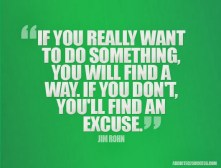
We talk about all the things we’re going to give up for Lent. Here’s an idea: let’s give up making excuses to avoid doing the things we know we need to do, or the things that will take us out of our comfort zone. We might find a whole new kind of energy. And if we put enough of those days together, we could create a whole new habit—and a positive one at that!

Jim-Rohn-Picture-Success-Quotes.jpg

(I’m still checking on the above quoted motivational speaker, Jim Rohn, so the jury is still out on whether I buy in to all his stuff. This quote, however, hits the nail on the head for me.)

Owning Up

empty nest.jpg

Being empty nesters has some wonderful advantages, but a few disappointments I hadn’t considered. One of the things that has changed is the ability to blame. For example, if the refrigerator door is left open or the last ice cube taken—it was probably me. And I’m the one who left less than a serving in the bottom of the cereal box.  The clearest example came, however, when I realized I had forgotten to replace the empty roll of toilet paper. I had no one to blame but myself.

raised hand.jpg
Instinctively, right before I dug in the cupboard to retrieve a new roll, I raised my hand. Do you remember how we used to do that when we played on the basketball courts of our childhoods? When we committed a foul we would raise our hand signifying taking responsibility for the transgression: “I did it. It’s on me.”

argue call.jpg

The same thing used to happen in professional sports. Not so much anymore. No, nowadays more often than not, when a foul is called by the referee the players go into some display of blaming others—even in the most obvious and flagrant of cases. Bottom line: people don’t accept responsibility.

This caused me to pause and reflect for a bit on the areas of my life where I have preferred to blame-shift spiritually. Over the years it’s been “easy” to point the finger at my parents or the fact we moved so often, and many other things. Enough already! I need to “man up” and accept responsibility for my own choices.

confession.jpg

That’s what confession is. Confession is raising my hand in the sight of God and owning that what he has identified as sin, as foul, in my life is true. I’m thankful when we do that, the Word promises: he is faithful and just and will forgive us of all our sin and cleanse us from all unrighteousness (1 John 1:9). That should free us from looking to blame and enable us to live more honestly!

1j1.9.jpg

Shrove Tuesday Thoughts

WP weight scale.jpg

Why do you diet? When I was younger, a certain number (whether it was clothing size or poundage) was the goal. I had a friend who was so tiny and I just wanted to be like that. Small equated with beautiful. Now, it’s not about size or number, it’s about health and the ability to keep up with my grandkids.
WP shrove tuesday.jpg
Why do you give things up during Lent? I’m following a devotional guide that was published for 2006. It makes the days off a little. Like today’s was about Shrove Tuesday. I learned a few things. For example, this was the day that those observant Christians would clear out the cupboards of the foods “not permitted” during lent. Those would include fat (hence the name Fat Tuesday), eggs, meat, and milk. It was the day of celebrating before the more solemn time of confession, reflection, and preparation to receive the joy of Easter.

WP indians.jpg

A few years ago there was quite a stir in the baseball town near me. Opening day was on Good Friday and good Christians who happen to be good Indian fans were in a quandary. How would they ever be able to enjoy a game without having a hot dog? Some went so far as to ask for special dispensation from the church. Isn’t that just like us?

We look at dieting as giving things up to get to a magical number, instead of what it is. Our diet is what we eat—all the time and every day. We either have a healthy diet or an unhealthy one. And it’s all about the long run. Spiritually, we need to adopt the same understanding. A verse came to mind while I putting this together. It’s originally found in the Old Testament, and Jesus picks it up in his teachings. The Shema tells us we are to love the Lord our God with all our heart, soul, mind, and strength. Jesus adds that we are also to love our neighbor as our self. Now that’s a spiritual diet we can live with!

Imagine it. How would life look if every choice we made was determined by whether the outcome would move us closer to completely loving God? Not just during Lent, but when we’re on summer vacation, or whenever. And you might be getting ready to assure me that you do that already, and have done it since you became a believer. Be careful how you justify yourself, Jesus may call you to deeper service (see Luke 10).

So, how’s your diet going this Lenten season? What have you gained by filling up and focusing more lovingly on the one who knows you best and loves you most?

WP shema.jpg


Advent: From Our Fears Release Us

WP 1john.4.18.jpg

In my quiet time this morning, I was reflecting on Psalm 3:

wp-psalm-3

Fear. Fear bordering on paranoia. Bullying.
I read a news clip this week of a teen who killed herself because her peers had been bullying her. My heart ached, for her, for her family, for those peers.
What if this psalm had been breathed into her? What if God, God who could enable her to lay down in perfect peace in the presence of her enemies–and sleep–had been made real for her?
How real is he to me?
Save us, God, from our fears.
The words to an old hymn are in my head now:

Come, thou long expected Jesus, born to set thy people free;
from our fears and sins release us, let us find our rest in thee.
Israel’s strength and consolation, hope of all the earth thou art;
dear desire of every nation, joy of every longing heart. (Charles Wesley)

Oh that we could come to know the Perfect Love that casts out all fear.

Advent 2: Seek and Find

Yesterday we made reference to the childhood game of Hide and Seek as we considered the phrase: Ready or Not.

Is finding God like the childhood game?

not well hidden.jpg

I don’t think so, and here’s why.

When I began my faith journey, two Bible references were laid into my foundation.

Seek the Lord while he may be found; call on him while he is near (Isaiah 55:6, NIV).

God did this so that they would seek him and perhaps reach out for him and find him, though he is not far from any one of us (Acts 17:27, NIV).

Our being able to find God is of primary importance to him. We were created for relationship with him–and with each other.

It’s so important, we’re so important, that the often quoted verse from John’s gospel tells us he gave his son for us to not only know who he is and how he is, but so that we could have that relationship–now and forever.

Jesus wanted us to understand this principle and made it clear in his teaching we refer to as the Sermon on the Mount: Seek and you will find (Matthew 7:7).

So in these season of focus, what are you seeking? Who are you seeking? If you are seeking God, you will find him.

jer 29.13.jpg


Advent Begins

hide and seek.jpg

Ready or not…here I come.

Classic line from a child’s game, right?

I think it’s the perfect way to start our journey of Advent.

Readiness. How is one to get ready? Are we ever really ready?

We rush around getting ready for “Christmas” by buying, baking, and decorating. We’re experts in the “rush and hurry” department.

But in our hearts and minds, in our homes, and in our actions, have made room to receive this amazing give that is full of promise and saturated with peace?

He’s coming ready or not. Let’s be ready.

Loving and giving God, giver of all gifts. You know what is on our list, but you know what we truly need. In this season where the focus is often on the trappings and externals, we want to focus (oh how hard that is) and make room for the gift of your son, your self. May the mystery of what that is and how that is unfold and bring us into deeper trust and faith. Show us the path that leads to readiness and help us to walk in it. Amen.

ready or not Jesus.jpg

Resting

(This is a reposting of a Facebook Note from November 1, 2009)

WP broken clock

Where I work I spend most of my time in two rooms, the kitchen and dining room. They are open to each other. In those two rooms there are four clocks. Should I venture into either bathroom there’s a clock there, too. I never have to wonder or worry about what time it is.

Time. When we think about it we wonder what time it is. We wonder if we’re late or early. How much time do we have? What do we do with our time? We’re accused of wasting time, marking time, stretching time, and watching time fly by.

I used to rush through my days. I was proud of how much I could cram into a day. More was always better and therefore, resulted in a better me. When I gave up sleep to focus on saving the world (or at least my little corner), I made some of the stupidest and most dangerous decisions, decisions that nearly cost me everything, including my life. I finally came to the conclusion that there is a reason that God rested and a reason that he commands it of us, as well.

This morning was the time to change our clocks. It was time to “fall back.” While others were relishing an extra hour of sleep, I was awake and at my computer. I was reveling in the quiet. All I could hear was the rhythm of the clocks ticking around me. Now maybe if I only had that to listen to 24/7, it would become tortuous, but sitting here this morning, it was a Centering Symphony.

I was up “early” because someone imposed a time change on me. Isn’t that just how life seems to go? We grouse and complain because our time is not our own. Someone always seems to be demanding our time.

Recently, I was a t a retreat where the leaders took the watches and phones of the participants. The surrender was to free those attending from the tyranny of time. The thinking was/is to let the staff “worry” about time and schedule. Good as it was, the staff always had someplace for the participants to go or something for them to do, so there was no sense of “free time.”

Compare that to the experience of our house guest. We have a couple unoccupied rooms in our home, so we opened our space to a pastor friend who was between jobs with no place to stay. The first couple weeks she was with us, all she did was sleep, eat, and watch TV. Our interactions were minimal. Slowly, opportunities and necessities began to reenter her life and she began to go out with friends and go to some meetings. One day she came through the living room where I was reading. She sat and we chatted for a while. At the end of our talking, she shared how much she appreciated the opportunity to just be there with no expectations, just able to rest. It was the refreshing that she needed at every level of her being: heart, mind, soul, and strength.

In the great Shepherd Psalm (Psalm 23), we find so much of the care provided to and for us. One of the things we may overlook is that he who knows us and our needs makes us lie down. Thinking of this reminded me of my grandson. I can always tell when Asher needs a nap. Some days so can he. Don’t make the Shepherd bop you on the head with his crook to get you to rest. We were not created to go 24/7.

One day as Jesus was ministering, he looked out at the crowd and was moved to compassion when he saw how weary and out of synch they were. He offered them rest, to restore their rhythm. To receive this gift they needed to come to him and learn from him. Don’t you think it’s time to listen, to learn, to rest?

Tracing and Anticipating

I wrote this in 2009 and posted it as a note on Facebook–it came up as “memories” reminder. I’m reposting it and will edit it later. I needed the message.
wp-tracing-abc

Our three year old grandson, Asher, started pre-school this fall. From the get go, we knew he was a bright child. He even came on his due date. We watched Baby Einstein videos with him until we all knew them by heart. Very early, he knew his shapes, colors, letters, and numbers.

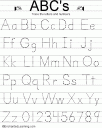
At Pre-school they are teaching the kids their letters and numbers and having them trace them. Asher walks around with his left hand in the air, at the ready for the next thing to trace. If he isn’t tracing the letters, he’s counting how many characters or letters are in the word or string of words. He traces letters on the TV, on boxes, on books, from the newspaper, or on the shirt someone has on. One day, I found him sitting on the floor in the dining room. We have a shelf there with accident/spare clothes for him. He had all his spare shirts lying out and his own shirt off. When I asked what he was doing he looked at me with that “isn’t it obvious, Mema” look. Then, as matter of factly as he could, he informed me that he was tracing. Every letter around him screams to be traced!

Reflecting on Asher’s tracing, I began to see three components that made Asher such a good tracer. First, he walked through his day, minute by minute and room by room, anticipating, no expecting, that there would be letters to trace or count. What do you eagerly anticipate? A quick read of Romans 8 paints a clear picture of what we need to be anticipating.

Anticipating that God is at work, that he has a plan and it includes us, drives us, spurs us, motivates us to be ready. Asher walks around expecting to find something to trace. His little hand is often in the air, making circles, like an airplane getting ready to land. The word tells us we are to be ready, to always have an answer when someone asks us what are hope is about.

Could you do that? I’m not asking if you know some specific plan or canned presentation. I don’t care if you have scripture memorized, but can you (from a sincere heart) tell someone, “This is where I was. This is what God in Christ did for me. And this is where I’m headed.” It’s your story, are you ready to tell it?

And finally, I have been so impressed by Asher’s focus. His questions reveal his passion to learn more. He listens to all our conversations. I know this because often my words come back to me through him. It has caused me to be more conscious of what I say and how I say it. We’ve even had to resort to spelling things we want to keep above his head. Everything he sees is an item to trace. If he’s not tracing letters, then his finger runs around the circumference or perimeter of an item. Some days he carries his step stool from room to room so that he can be sure to catch whatever you’re doing.

Right now Asher seems to be practicing the fine art of learning. It reminded me of Brother Lawrence’s continual practice of the awareness of God. And I started to wonder: what keeps me from anticipating God at every turn? Do I have preconceived and limiting notions about who God is and what he can do? What keeps me from being ready? Is it fear, or busyness, or ignorance of the urgency, or God help us: lack of love? What keeps me from being focused? The enemy is the expert at divide and conquer. If he can get us to thinking in terms of sacred and secular, he knows it’s just a short distance disconnecting our head and heart.

When I was in seminary the second time around, a Sunday School teacher asked our younger daughter, Beth (Asher’s mom), what she wanted to be when she grew up. Beth’s answer struck the teacher enough that she made sure to tell me. Beth’s answer was, “a student like my mom.” There is always a need for us to put into practice what we know, but oh, that God would rekindle in each of us the insatiable desire to learn.

Then we would, like Asher, be anticipating, ready, and focused.

wp-asher-scrabble-3

Book Review: The Imitation of Christ, Classic Devotions in Today’s Language

BR imitation of christ.james watkins.jpg

One of my favorite movies is a sappy romantic comedy called, “Kate and Leopold.” In the movie a character from the late 1800’s ends up in the 1990’s. In one conversation the stars have, Kate asks Leopold what he misses from his time. His response is that he misses the pace. Modern time is to fast and chaotic.

Perhaps that is why I love Peterson’s translation of Jesus’ invitation in Matthew 11:29. We are invited to “catch the unforced rhythms of grace.”

As I began reading this modern translation of The Imitation of Christ, I felt the pace change. I sensed an unusual, but very comforting rhythm. I found I couldn’t help but slow down–and in the slowing, go deeper.

There has always been a timelessness about the message of the original work, but now people can more easily hear it and hopefully be changed by it. I love how the messages flow from the Christ and from the Disciple. We are so naturally tuned into the message and pace of the world and this books speaks to that…and to us.

I would strongly recommend this book for personal study, but also see how it could be beneficial to study it’s message in a small trusted group. There is much to be gained from the accountability with other believers.

The only thing that would made the book better was more room to write in the margins. I found many times when I wanted to respond to the Christ as the disciple did.