Sermon Seeds: Faith and Foundation

SP faith blocks

I’ve been meditating all week on Bible verses about faith. Here are a few:

Now faith is confidence in what we hope for and assurance about what we do not see. Heb. 11:1

And without faith it is impossible to please God, because anyone who comes to him must believe that he exists and that he rewards those who earnestly seek him. Heb. 11:6

So faith comes from hearing and hearing through the word of Christ. Ro. 10:17

SP faith roots

And Jesus answered them, “Have faith in God. Truly, I say to you, whoever says to this mountain, ‘Be taken up and thrown into the sea,’ and does not doubt in his heart, but believes that what he says will come to pass, it will be done for him. Therefore I tell you, whatever you ask in prayer, believe that you have received it, and it will be yours. Mark 11:22-24

The apostles said to the Lord, “Increase our faith!” Lk 17:5

I have fought the good fight, I have finished the race, I have kept the faith. 2 Tim. 4:7

So you see, faith by itself isn’t enough. Unless it produces good deeds, it is dead and useless. James 2:17 NLT

What I’m about to tell you is true. If you have faith as small as a mustard seed, it is enough. Matthew 17:20

So, how is your faith today? Growing? Fading? Active? Passive?

Today as I was reflecting and preparing for Sunday’s message, I realized I’ve been pretty comfortable with where my faith has been. You can translate that as stagnant. I don’t feel good about either of those words. I went to front of our sanctuary and knelt in prayer. And wept.

I talk about the great things God wants to do in this church, in the lives of this body of believers, in this community…in me. But am I willing to step into that growth, willing to take on the changes for me? That’s scarey…and it’s all good. God’s promise and plan shouldn’t be a fearful thing.

So this revelation is going to cost me. Bonhoeffer wrote that there is no cheap grace…the same is true of faith.

This thing we call faith is the foundation for everything we build your spiritual life upon. We need to make sure it’s rock steady.

WP faith foundation

Faith the Final Frontier

29 Then Jesus told him, “Because you have seen me, you have believed; blessed are those who have not seen and yet have believed.” John 20:19

WP knitting instructions

I learn best when I can watch someone or I can see an example. Following written instructions, like how to crochet or knit, or even utilize a new cooking technique, ties my brain in a knot.

Thomas is my kind of guy. Show me. I need to see this incredible thing, because it’s just too complicated for my mind to grasp. It does not make sense.

Thomas responded skeptically, but he’s not the first person in the Bible. Sarah laughed when she heard God’s plan. Zechariah wanted a few details when he knew he had to explain to Elizabeth what God was doing. Gideon questioned God’s strategy for his army several times…just to be sure.

I get it. The things God does and says are bigger than our minds. He owns this principle: my ways are not your ways (Isaiah 55:8).

So even though Thomas “doubted,” Jesus appears and allows him to touch his side and hands. Thomas wasn’t kicked out of the club because he was confused. That is good news!

WP but wait
But wait there’s more! Here’s the better news—news for you and me: blessed are those who have not seen (who don’t get your opportunity, Thomas), and yet believe.

That’s us. Looking into Thomas’ eyes, Jesus saw you and me. He knew how hard it was going to be to wrap our brains around resurrection. And he issued a “trust me” statement.

We have to take this one on faith…and if we will…we will be blessed.

PRAYER: Father, when you looked at Thomas kneeling there in reverence, believing because you revealed yourself to him…you saw me. And when you saw me, you knew it wasn’t going to be easy to believe. Thank you for extending your blessing to those of us who have not seen you in person, but who see you by faith. Please continue to show up when we have questions and reveal yourself. Open the eyes of our hearts to see you today, for you are our Lord and our God. Amen.

WP truly blessed

When Will I See You Again?

For we walk by faith, not by sight, (2 Corinthians 5:7)

WP FCWC

I’m at Florida Christian Writers Conference. It’s a great place to be on so many levels. For one thing, the weather here is delightful. I’m also improving my craft, networking, and making new friends.

So, it might make more sense to you when I tell you I walked out on my balcony and prayed: Lord, where will I, when will I see you again? (And then I started singing, “When will I see you again?” by the Three Degrees…it’s on youtube if you need an earworm)

cropped-cropped-bible-cover1-e1409451218595.jpg

I love my regular times with the Lord. Morning routines of prayer and attention to the Word can put such a positive energy into the beginnings of my day. If there’s a sunrise or a sunset filling the sky, it feels like God is tapping me on my shoulder reminding me he’s still there.

I have an “unscheduled” personality. When I take personality trait inventories, I come out on the side of less consumed with calendars and organization and with a far greater need to “fly by the seat of my pants.” (Ok, in MBTI terms, I’m off the scale P.)

Maybe that’s why I find it much easier to walk by faith. Sure, I’ve had to learn my God will provide and he has a plan. Trust often comes slowly. But I don’t need to know exactly how he’s going to do it. I’ve read the end of the Book, I know how things are going to end—we win! (Hope I didn’t spoil it for you.)

WP walking blindly

Walking by faith doesn’t mean I’m walking blindly. I know how God operates. And I’ve learned I can trust him.

Walking by faith means I expect to see God at every turn, around every corner, in every encounter.

WP peek around the corner

And when I chose to walk this way, it is amazing what I see!

PRAYER: When will I see you again? Oh God, those words do not come from a doubting heart, but a heart believing you can be found all the way throughout my day. Those words come from a heart anticipating you will show yourself in amazing ways. Looking forward to seeing you.

Surrender

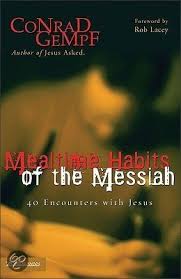
We started our study of Conrad Gempf’s book, Mealtime Habits of the Messiah in our Sunday school class last Sunday. And as I suspected, we didn’t get very far, very fast. In fact, we only got through half of the introduction. Lest you wonder…this is a good thing. There was much discussion and participation. Our class has grown so much that we have to find a better way to squeeze us in–such a glorious problem!

So while I was studying and preparing for the upcoming class the topic of surrender was mentioned…but the way my mind stuck on it you would have thought that it was the main theme. Rumination at its best.

Surrender. Not a popular word. Somehow it has become the definition of weakness, of defeat. We don’t want to surrender to our enemies, our spouse, our boss, our grandchildren. And yet we daily surrender to our passions, our obsessions, our addictions. Go figure.

For a bit, I want to focus on what surrender means in the spiritual sense…at least for me.

Here’s the problem as I see it: we think surrender means giving away everything and getting nothing. And somehow in that process I get lost…the me that I am, is gone. If I surrender to my spouse I cease to exist and it’s only them. If I surrender to God…then there’s no me. And we can’t fathom not being. That’s why we fight death so fiercely.

Until we begin to understand God, this surrender thing makes him seem like some cosmic terrorist: why surrender? He’s just going to kill us anyway.

Our thinking is really twisted…thanks to the great deceiver and the work he’s been at since the garden. See, he started his number on the first folks, Adam and Eve–and primarily Eve. His job has been to distort God’s purposes and He’s really quite good at it and we’re really quite sucked into it. His opening remarks were to twist the words and purpose of God’s reasoning. “Did God really say that?” “I’m sure that’s not what he meant.” And then she bit and bought the apple.

What does this have to do with surrender? Everything. We think everything is ours and to get a piece of God we have to give it all up. As if to hold God in my hands I have to lay my stuff down. And there in, or in there, lies the problem.

Nothing I have is mine. It may be in my possession, but it doesn’t belong to me. Having trouble with that? I understand. I was dealing with my grandson on the concept just the other day. He was playing with a neighbor boy, who happens to remind me of Eddie Haskill (if you don’t remember Leave it to Beaver, go look it up on youtube). He’s older than my grandson and constantly tries to take advantage of his naivety. Especially when it comes to trading. (This is a boy concept which I don’t get very well.) Eddie-boy tries to grandson to give him something or things and in return gives him junk that he tries to pawn off as really great stuff. Grandson wants to be friends with Eddie-boy so he goes along with it.

This trading isn’t too big a problem until grandson starts to trade off the stuff that we have paid for (aka: of high value to us as it should be to him). That’s when I step in as the enforcer and put the kibosh to the whole thing. The last incident left grandson in tears and confused and me trying to explain. I wanted grandson to know that we provide these things for him so that he will have things to do and play with while he is at our house (daily). He is allowed to play with them and in some sense they are his things, but they don’t belong to him. He is also charged with the care of these things.

The more I thought about this, the more I realized that this is how God sees things, too. He provides it all–but it’s still his. All he asks is that we acknowledge that and take care of it.

I think that was why the Rich Young Ruler (see Mark 10:17-27) had such a hard time when Jesus told him to sell all that he “possessed” and give it to the poor. He didn’t really understand who the true owner, possessor, was. He really bought the lie (of the evil one), and thought he owned it. He thought to give it, to surrender, meant that he would lose it all. As if to think that God really needed his possessions? I don’t need to own all my grandson’s toys. In fact, when he’s grown and gone, so will the toys. It would just be nice if he recognized the provision occasionally, but that might be a lot to expect from a seven year old.

But we’re adults and it seems to be what God is asking of us.

Could this be what Paul was saying to the Romans (Romans 12:1-2) when he describes our reasonable service/sacrifice as one that is living? He says God wants a living sacrifice. That is what is holy and pleasing to him. Too often we think we quit living if we surrender.

(I just had a moment…a thought…I was thinking about Abraham offering Isaac. There seems to be some parallels. Would God have allowed Abraham to kill Isaac? Or was he wanting to see if Abe would give, surrender his son–give back to God what ultimately was his anyway? Going to have to think on this some more.)

If you’re still reading along with me, then you have exceeded blogdom’s suggested word count and I thank you. Let me hasten to close…

Surrender is not to be feared or avoided. In many ways it reminds me of how I define confession: agreeing and owning what God already knows about me. Surrender is recognizing who truly owns everything and receiving it back as a trust–whether it’s my life, my money, my toys…you fill in the blank. I’m not, you’re not, the owner, but the steward.

And here’s a thought: God trusts you with his very best and treasured possessions. How will that impact your living?


The Message in the Silence

This morning my daughter posted this on Facebook: Why is it that your kids don’t seem to hear you unless your yelling at them, but then they give you that pouty face that makes you feel sick for having yelled at them so they’d finally listen?! Being a parent sucks!

I will admit that my first thought was to smile, thinking of all the yelling I did when she was my strong willed always right closed minded child. We raise them to be independent and have opinions. We just don’t realize that they’re going to develop those so early and with such strength.

Reading her post got me thinking about my own childhood. My mother wasn’t a yeller. That’s not to say she couldn’t—I received my share of loud scoldings. My mother had three other weapons in her arsenal that often left me wishing she was a yeller. First, she was the master (perhaps even the inventor) of “the look.” No word needed to be spoken; message received loud and clear: cease or die. What was most amazing to me was when she used it on other kids at stores or other public places and they got the message too!

The second tool that my mother relied on was action. We knew that mom would not hesitate to use whatever was at hand or just her hand to make her point. This resulted in my brother getting konked on the head the telephone receiver when was making too much noise while she was on the phone (phone calls were typically fewer and much more important back in the day). Hair brushes, yardsticks, and those stupid paddle ball paddles—looking back I now see why she was always willing to give into that childish indulgence as we checked out at the store. You think we might have put that together better.

But the most effective tool in my mother’s parental arsenal was silence. Silence typically conveyed one of two messages, both extreme. She was either extremely disappointed or so angry that if she said anything she would have exploded. This final weapon was so powerful that it always got our attention and resulted in our praying for the silence to end.

As I am writing this, I am on the mend from a very weird and pain-filled three weeks. I progressed from swollen feet to extremely swollen feet and ankles and pain while walking to nodules all over my legs and arms and in my joints (elbows, wrists, fingers, knees, ankles toes), to fevers and shakes. I’ve had so many blood tests, I feel like a pin cushion—the very nice woman in the outpatient check-in knows me by name. I had a punch biopsy. Standing was so painful. At times I admit I just melted into tears. And I just couldn’t shake the thought: what if this is as good as it gets? I believe in healing, but I know that God doesn’t remove every infirmity.

Now, I realize that my suffering was probably very light compared to others. But it was mine and for a relatively active and healthy person this was intense and scary. Perhaps the was the worst: not knowing what was going on and not knowing how long it would continue.

Getting quiet with God this morning, thinking about my daughter’s post and my pain, I found myself thinking about the times I cried out to God these past few weeks. I began to feel like Malachai: how long, God? Silence. I wanted to be angry, to decry what seemed so unfair. But I couldn’t. Because somewhere in the silence there was a drawing…a calling…a voice…trust me.

At first I thought my pain was God “screaming” at me, me the errant, disobedient child. Punishing. Then it seemed more like a “smack” of sorts to get my attention. But each of those fell short. All my experiences with the silent messages from my mother were good for one thing for sure: they taught me to listen, listen hard, and listen long—for the answer is always there in the silence. At least it has been for me.

But like I said, I appear to be on the upswing. Maybe that’s why Job didn’t curse God when his wife suggested it. She wasn’t evil, she just ached to watch him suffer, and was suffering herself. Hope dies hard. Even if the pain I was suffering was going to be my friend for the rest of the journey, I would have adapted…somehow. And I know that God would have been with me. That was the kind of answer that Malachi got. God let the prophet know that he wasn’t going to like the answer to his question because God was going to use his enemy to bring about His purpose. It was the same message for Jeremiah (read ALL of Jeremiah 29).

I don’t know how it goes for you, but I tend to struggle with trying to fix and control. Trust doesn’t always come easy, but I usually get there. Just like when I was a child. Just like when I dealt with my own children. Sometimes learning is hard, as my daughter is finding. Parenting, too. Just ask God.

He’s Outside the Box


Getting ready for Bible study/translation this morning, I was again caught in the prayer of Paul for the Philippians:

14 For this reason I kneel before the Father, 15 from whom every family[a] in heaven and on earth derives its name. 16 I pray that out of his glorious riches he may strengthen you with power through his Spirit in your inner being, 17 so that Christ may dwell in your hearts through faith. And I pray that you, being rooted and established in love, 18 may have power, together with all the Lord’s holy people, to grasp how wide and long and high and deep is the love of Christ, 19 and to know this love that surpasses knowledge—that you may be filled to the measure of all the fullness of God.

20 Now to him who is able to do immeasurably more than all we ask or imagine, according to his power that is at work within us, 21 to him be glory in the church and in Christ Jesus throughout all generations, for ever and ever! Amen. (Phil. 2:14-21, NIV)


Okay, here’s my quick thoughts on this: Paul is prayer seems to give the dimensions of a box. As I pondered this, I was rudely transported back to high school geometry class–the seedbed of so many nightmares. One positive thing I did gain from that class was the encouragement to consider the multi-dimensions of things: life isn’t one dimensional, flat. Paul seems to be trying to get the Philippians to realize this same thing about God.

No sooner has he drawn them a box, then he goes on to clearly point out how God is outside the box. There is no box that can contain him. He is the God who is exceedingly abundantly about all we could ask or imagine. Wow!

When my girls were little, they could spend hours playing in empty boxes, especially empty appliance boxes. My grandchildren must have inherited the same gene. There is so much that can be done with a box. So many worlds that one can create with a little imagination.

My girls outgrew playing in boxes. The same will probably happen with the grandkids. And that’s okay. Life is meant to be lived outside the refrigerator box.


God wants us to outgrow the childish boxes we may have kept in him, too. What would happen if you let him out of the box? How would your spiritual life change if you allowed him to be bigger than you’ve imagined him to be? How deep, high, and wide is your experience of his love?


I’m going to play–live–outside the box today. I’m not sure what it will look like…but I’m willing to look. How about you?

Way to Go Lady!

There are some biblical characters that I really enjoy!  The Syrophonecian woman is one of them.  (See Mark 7:24-31)  Jesus has just come through what seems to be a highly irritating exchange with the Pharisees and scribes.  Their hardness and heartless adherance to the traditions of the elders (This always reminds me of the nameless “they” in “they say”) along with the slowness of his own disciples left him drained and needing some down time.  So he goes to find some rest at someone’s home.  But there is no rest to be had.

I find it  quite interesting how a pagan woman got to where Jesus was seeking to hide.  The disciples have been so good at shooing away people and children, but somehow, she gets through.  According to the Greek she doesn’t just ask Jesus a question, she makes her request over and over.  It sounds somewhat annoying. So I guess in part, Jesus caustic response might be more understandable given his exhaustion and her persistance. 

A cursory reading of the story leaves wondering some things.  In addition to wondering how she got in: does she expect Jesus to come with her?  Had she heard about how Jesus seemed to provide a magical “remote” healing of the Centurian’s daughter?  If not, why didn’t she bring the girl with her?  How sick or what kind of demon possession did she have?  What was her name?  These are the questions that go through my mind at first glance.  Then I peel back a few layers and I really wonder, why was Jesus so sarcastic with her?  Didn’t he just get done rale against the Pharisees and their blind following of tradition?  Wasn’t Jesus’ comment just another form of Greek/Pagan bashing that would support their pharisaical mindset?

The only way I can read this story and make Jesus’ behavior make any sense is to see it as a possible teaching moment for those who were listening.  I think this way based on Jesus’ openness to healing those outside the Jewish faith.  He didn’t hesitate to heal the Centurians child, or Legion.  In John 4, it states that Jesus “HAD” to go through Sammaria, which resulted in his encounter with the woman at the well, when clearly that wasn’t the best way to travel.  So it would make no sense that all of a sudden Jesus had nothing to offer this woman.

I wrote the previous parts to this post last week.  Today we moved on in our study of Mark and covered Mark 8:1-21.  The beginning portion of this chapter is Mark’s report of the feeding of the 4000.  There is a lot of discussion regarding this second miracle.  Some commentators wonder if it’s just a repeat, an error, that there really wasn’t a second separate feeding.  Many feel that there were significant differences which possibly point to not only a second feeding, but a feeding that focused on Gentiles.  Those who support this thinking point to the number of loaves and baskets of fragments, seven, because seven and seventy are important numbers to the Gentiles. Also the fact that Jesus didn’t have to worry about the crowd pressing him to be a leader who would overthrow the Romans–the Gentiles didn’t have as big a beef as the Jews in this regard.  But the thing that stuck out most clearly to me was just the placement of the miracle: on the heels of his encounter with the Syrophoenician woman.

Could it be that Jesus did go to this woman’s home or region?  Could it be that her faith prompted his trip and the resulting three day teaching?  This miracle doesn’t appear to be the teaching opportunity for the disciples that the feeding of the five thousand was.  Here Jesus is prompted to feed these people out of sheer compassion, concern that if he sent them home they faint along the way.  In the first miracle the remnants that the disciples collected were described as small pieces, or crumbs, while here the leftovers are much larger pieces and they filled large baskets not the beggers baskets Mark describes in the sixth chapter.

I know it’s mere speculation on my part that there is any connection, but how many other things do we believe that are conjecture or interpretation?  Who’s to say it didn’t happen this way?  I like thinking about what a difference this woman could have made with her faith–and it wasn’t just about bread.  I imagine there was great joy as she shared her story.  I believe that others came to Jesus with a spiritual hunger that far outweighed their need for bread.  And if it did happen that way–I think they were fed to over-full.

When I think of this woman’s faith, I’m humbled and challenged.  Do I feel entitled to something big?  Will I accept the small miracles of daily grace that come my way?  How faithful am I about telling my story?  Do others see Jesus in me?  I want to feel close enough in my relationship with God that what other might see is imputance, God will interpret as holy boldness. 

There’s just so much to glean from this story.  But what I hear myself doing the loudest is cheering her on: Way to go girl!