Sermon Seeds: Stealing from God


4602EA0B-8B36-44E8-9781-C7442C3A0D0D

We live in a world that blesses, condones, and encourages stealing…but condemns the thief.

Many are drowning in debt because they keep taking and taking, buying and buying, what they can never afford.

Even our language betrays our behavior: we “borrow” from Peter to pay Paul. We’ve done our best to minimize the sting, even glamorizing the sin: we pirate, we embezzle, we reappropriate.

And that’s just what we do with money.

But I want us to consider two stories from the Bible that we might not immediately link to stealing—and how they might relate to us.

In Mark’s gospel, chapter 5, we find the story of a woman who had been ill for a dozen years. No one in that day was able to bring her relief and because her ailment deemed her unclean (and therefore medically and socially isolated) she was doubly desperate to find relief.

She hears of this miracle working man. She didn’t care about the talk about him possibly being the long-awaited Messiah—she just wanted to stop hurting and stop being alone. So she decided to find him, follow him, and to sneak into the crowd and steal her miracle.

She can’t go to him. She can’t even be in the crowd. Her plan: slip in and slip out. No one ever needs to know

Jesus knew the instant her fingers touched the very edge of his robe.  And she was caught in the act of stealing from Jesus.

But instead of calling the law keepers, he met eyes with this woman and assured her it was her faith that made her well.

When he looks at her, he doesn’t call her a theif, he calls her daughter. He identifies her as family—as his own.

Why do we, like this woman, try to steal what God wants to give us? Why would we rather be thieves instead of children?

The other story can be found in Matthew 21. Jesus is angry in this story, angry and violent. Here we see Jesus on the attack, clearing the money changers out of the temple.

Have you heard the old saying: give them an inch and they’ll take a mile? That’s what had been slowly happening in the temple. Initially, there was provision made for those who traveled great distances to purchase their items for sacrifice in the outer courts. Over time, and with the growth of business, the questionably proiftable business had spilled over into the area where there was to be prayer, not buying, selling, and price gouging.

It was sanctioned theifery. It was big business. And those who were profiting had the power in a place where the power—and the glory—was supposed to be God’s.

And Jesus decided to do something about it—and he didn’t just upset the apple cart. He infuriated those who had come to depend on their ill-gotten gain to support their cushy lifestyle.

He ticked off the wrong people and it played a major role in getting him killed.

What can we learn from these two stories: we have to stop stealing. Because when you peel back all the layers: when we steal…we are stealing from God.

Most of us learned the Shepherd’s Psalm as children, Psalm 23. Perhaps we need to remind ourselves how it begins: The Lord is my shepherd, I shall not want.

What does that mean? The Lord (God, the creator of the universe) is my provider and keeper. He has it all. And he provides for my every need. I HAVE everything in Him that I will ever need.

Okay, one more story image. Remember the younger son, often referred to as the Prodigal? In essence he “steals” his inheritance, runs away, and because he’s not mature enough to know how to handle instant wealth, he squanders it—and ends up destitute in a pigpen. (You can read the story in Luke 15)

Coming to his senses, he realizes how foolish he had been and decides it was so bad back on the farm, so he heads home.

When he gets there, Dad is so happy to see him, he throws a party to welcome him home. Even though the lad had in essence wished his father dead—Dad kept loving and providing.

That’s how God works.

How much easier our lives would be if we could just come to him with our needs instead of trying to find ways of meeting them on our own.

Prayer Thoughts: Father God. Forgive me for trying to take what isn’t mine. Forgive me for not trusting that you who are not bound by time, who can see the beginning and the end (and I will admit that’s a tough one to wrap my puny brain around), not only know what I need, but when I need it—and you want to give it to me. Give me the courage to get out of the mess, the pigpen, I’ve made and help me put my life back in order. Thanks.

BCF3402F-564D-4E1C-ACD6-10E9C5798914


Hopefully Devoted: Melancholy 1-Tina 0

506C9956-4596-4AA8-B5DA-630896CD0346

It’s been a rough morning. A wrestling with God morning. An unhappy with my life morning.

I’m not sure I can convey how difficult it is for me to own that.

But I’m trying to read this book—I desperately need to—and I’m finding it hard to get past the title: No More Faking Fine.

My parents were alcoholics—faking fine is one of the inner-workings of a child growing up in that environment. You can’t reveal the family secret…to anyone! Every thing is fine.

My husband is chronically depressed. Most of the time he functions acceptably, but there are seasons when the melancholy threatens to pull him under and me along with it. I don’t want to draw attention to it—so I pretend, with my own smiling mask..every thing is fine.

I could go on, but there isn’t any need. Suffice it to say: today the melancholy is rocking my little boat and I’m not finding the energy for every thing to be fine.

So this morning, contemplating what in the world I could write about, I reach for my devotional, A Guide To Prayer For All Who Walk With God (The Upper Room), and start reading in the week of the Second Sunday of Lent.

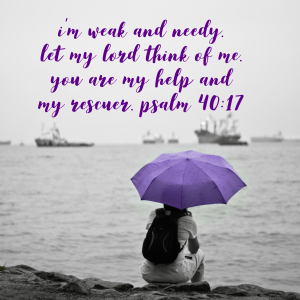
First thing I read, “I’m weak and needy. Let my Lord think of me. You are my help and my rescuer (Psalm 40:17).”

And then, “Amidst the tumult of thoughts the world jars loose in us, does not the season of Lent quietly invite us to pause and take stock of ourselves? (John S. Mogabgab, Weavings, May/June 1995)

Perhaps that is what I am to surrender for Lent. Yay! I can still have chocolate. But I cannot fake being fine. Chocolate might have been easier to give up.

Prayer Thought: Fan the flames of your love in our hearts, O God. Breathe life into the dry bones of our faith. Buoy our sagging spirts. Restore the joy of our salvation. All glory is yours. Amen.

DC1A5063-C1AF-4B67-A3FC-5F91F759DAE5

Wednesday’s Word: Secure

565F84AD-7FD5-4A2B-9A18-D05A55488512

We live in a time when insecurity runs rampant, infecting and affecting even believers.

In many ways we are similar to those who walked with Jesus. We are surrounded by religious professionals whose focus on perfection and rule keeping, leaving us wondering if we’ll ever be good enough.

The question which feeds the insecurity seems to be: “how will I really know if I’m going to make it?” This is usually followed with some form of confession: you don’t know what I’ve done.

The verse on our meme today comes from Romans 8:39, and Paul is pretty clear: NOTHING. Nothing we’ve done. Nothing we’ve said. Nothing that is happening to us.

God want us to know we are secure in him.

Message Meme: Don’t Take It

F88BCD0C-F86D-48FF-AE4B-AB1351625E82

Have you ever stolen something?

I’ve always hated that question. Mostly because I have to own up—yes, I have.

I took penny candy from the Fast Food Market in grade school.

Last week I even took a pen from the office where I was taking a class the other day.

I took a few extra minutes on my break a couple of jobs back.

I took five extra miles per hour on my way to the meeting I’m at.

I robbed someone of a blessing by declining their kind offer of assistance.

I robbed God of his glory by not giving him the credit due, or sharing his love.

I don’t think I’m in this boat alone. We could probably all own up to taking what isn’t ours. That’s what makes this commandment so important.

But why are we so prone to take what isn’t ours? More on that in Friday’s Sermon Seeds.

Prayer thoughts: Father God, this rule is hard. And the reasons we take are only symptoms of a greater heart issue. Help us to trust that you really do give us what we need so we can turn from this insatiable consuming greed—thinking we need more than we do. I want to be done with that apple. I want to bask in your lavish love and ample provision. Now, and always. Amen.

Selah: Listen

8FD0C456-A093-4A99-87E7-3F4777F2D35A

It was one of my favorite stories as a child. Young Samuel has just gone to bed when he hears a voice call his name. He runs to Eli, who has also turned in for the night. Eli assures Samuel he didn’t call for him and sends the lad back to bed. (See 1 Samuel 3)

The second time Eli might have been a bit peeved, but responds kindly—this was a new situation for the boy. Mumbling under his breath something about not being a nurse maid, he instructs Samuel to get back in bed.

When Samuel appears the third time, I imagine Eli’s immediate response was about to be less than kind—when it suddenly dawns on him Who is calling the young child’s name…God!

Words get sucked back, and Eli wakes up enough to tell Samuel exactly what he should do if the voice calls his name again, say this, “Speak, Lord. I’m ready to listen.”

Are you ready? Being ready isn’t always convenient, or easy, or even welcome. But I believe it’s important to listen…and obey.

I believe the voice of God can come as silently as a nudge, a gut check, or a hug around your heart.

I also believe the voice of God can sound like the voice of a friend, a spouse, or maybe even a pastoral leader.

Sometimes I’m listening hard, sometimes I’m asleep, sometimes I’m not even paying attention.

At times I try to pretend I’m too busy to be bothered. While other times I’m afraid so I fill my ears with other noise—like a child covering her ears and singing loudly: Lalalalalalala.

But I need to listen, especially if I identify myself as a servant.

And I need listen, to hear and obey.

”Go ahead Master. I’m listening. What do you have for me today?”

I’m ready.

Sermon Seeds: Adulterous Generation

760E9F05-A61A-4CAD-9244-C8302E86A501

At one point in Jesus’ ministry, the Pharisees and Sadducess (recognized religious leaders of the day), demanded that he give them a sign to prove his authority.

“A wicked and adulterous generation demands a sign, but none will be given it except the sign of Jonah.” Then He left them and went away (Matthew 16:4, Berean Study Bible).”

Adulterous.

Aldultery we think we understand. But what about adulterous?

Understanding this word better will help us understand why this commandment is so important to God, and why Jesus spoke about it on more than one occasion.

I went to the Thessaurus to find words that might help us. Consider these: illicit, fast and loose, immoral, cheating, two-timing, moon-lighting.

What about antonyms or the opposite: chaste and pure. To those I would add loyal and committed.

Isn’t it interesting that when God begins this section of rules and commands, he starts by demanding a pure and chaste relationship with himself?

Our relationship with him becomes the standard for our relationships with our mates and with others.

But we’re not naturally wired that way. One of my favorite hymns puts it this way: “Prone to wander, Lord, I feel it. Prone to leave the God I love. Here’s my heart, oh, take and seal it. Seal it for thy courts above (Come Thou Fount).”

We are prone to wander. We have wandering eyes and wavering commitment. We are tempted to move to whatever seems better than what we have—whether it’s a car, house, a job, or a mate.

We flirt with the new until our heart forgets the promises we made. Our reckless and riotous living is similar to the prodigal son described in Luke’s gospel. We don’t appreciate what we have, so we take what’s not ours…and the chasing and wandering lands us starving in a pig sty of our own making.

The solution? Return to the God who knows us best and loves us most. The God who specializes in restoring because he never stops loving.

And if you haven’t wandered yet? Keep your heart pure!

Just in case you think purity is impossible, God has a word—a promise—for you (and me!):

FD2FF507-3CA4-45CB-B697-84F0B290BFE6


Hopefully Devoted: Touch

32F23F66-094A-4076-9D7E-662973524618

This week I read a quote on one of my current favorite blogs, Live and Learn, by David Kanigan:

The skin hungers for touch, from cradle to grave. “Close silence—that’s all they need,” she whispered to me. (Kelly Corrigan, Tell Me More: Stories About the 12 Hardest Things I Am Learning to Say, January 9, 2018)

Thinking about this hunger for touch reminded me of the story Mark tells of Jesus healing the man with leprosy.

The Greek word is splagcnizomai. Bible Study Tool (online site) gives the definition: to be moved as to one’s bowels, hence to be moved with compassion, have compassion (for the bowels were thought to be the seat of love and pity).

Knowing this, it troubled me when the NIV translates the word as “indignant” and the footnote in the NLT states that some translations use, “moved by anger.” Righteous anger might be indicate if one considers the ostracization of this man because of his condition.

Standard protocol would dictate that Jesus would give the verbal healing before he touched the man—but that’s just not how Jesus worked.

Could there possibly be anything this man needed more than physical healing?

How about human compassion and contact…touch.

Oh, the difference that’s made by the touch of the master’s hand.

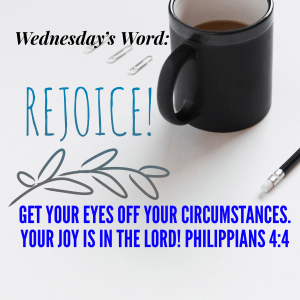
Wednesday’s Word: Rejoice!

EFD48ACA-6646-40D1-8A35-92D24A231C24

James instructs us to “count it all joy!” (James 1:3)

Jesus told his followers: “I have told you all this so that you may have peace in me. Here on earth you will have many trials and sorrows. But take heart, because I have overcome the world (John 16:33, NLT).”

The world may feel like it’s falling apart, but maybe it’s really just falling into place.

Message Meme: Purity

64CDE491-4BDE-4743-A8DD-8C635A0970FF

This week we will consider the seventh commandment: Don’t commit adultery.

According to Matthew Henry’s Commentary (1839): The seventh commandment concerns chastity. We should be as much afraid of that which defiles the body, as of that which destroys it. Whatever tends to pollute the imagination, or to raise the passions, falls under this law, as impure pictures, books, conversation, or any other like matters.

Is it naive to believe that moral purity is possible?

God promises that the answer is a resounding, “NO!”

His divine power has given us everything we need for a godly life through our knowledge of him who called us by his own glory and goodness. Through these he has given us his very great and precious promises, so that through them you may participate in the divine nature, having escaped the corruption in the world caused by evil desires (2 Peter 1:3-4, NIV).

Every thing we need to escape the corruption in the world.


Year In Focus: Thinking

8 “For my thoughts are not your thoughts, neither are your ways my ways,” declares the Lord. 9 “As the heavens are higher than the earth, so are my ways higher than your ways
and my thoughts than your thoughts. (Isaiah 55:8-9, NIV)

Yesterday during worship we had a time of anointing and prayer. During our congregational time of sharing, a family member shared, from a broken heart, a desperate need of a family member. I felt nudged in my spirit to focus on the need, the individual, and the family.

As I began to pray, I sensed a childlike spirit—more like a self-centered, spoiled child wanting to demand my way. I didn’t understand what God was thinking, why he was allowing this horrible suffering and grief. My first thought was to tell God what he needed to do in this situation.

Now here’s one of the difficult things for me as I pray publically: even when I am aware of leading others to the throne of grace, I get there first and at times God starts working on me—and that’s what I felt happening.

Trust me.

But God…don’t you understand?

More than you’ll ever know.

So I don’t have to tell you what’s happening.

No. But I care about what you’re feeling. Go ahead and pour out your heart.

SELAH (Pause, reflect, and connect)

The truth is: we don’t naturally think like God or see things from his perspective. Can we? Will we ever?

I really don’t know to what degree we will, but here’s what I do know: God is in the business of transforming our thinking, maturing our understanding. And I know this because he tells me in his word:

Do not conform to the pattern of this world, but be transformed by the renewing of your mind. Then you will be able to test and approve what God’s will is—his good, pleasing and perfect will (Romans 12:2, NIV).

Let this mind be in you which was also in Christ Jesus (Philippians 2:5, Berean Study Bible).

Jesus extended this invitation to those weary from trying to “do” religion, trying to understand God—those who were ready to give up:

Come to me, all you who are weary and burdened, and I will give you rest. Take my yoke upon you and learn from me, for I am gentle and humble in heart, and you will find rest for your souls. For my yoke is easy and my burden is light (Matthew 11:28-30, NIV)

Is your situation confusing? Overwhelming? Having trouble finding the mind of God? Stop trying to make sense of things with your limited knowledge…trust the heart and mind of God. He is gentle and humble, and you will find rest for your souls.

SELAH