Year In Focus: Thinking

8 “For my thoughts are not your thoughts, neither are your ways my ways,” declares the Lord. 9 “As the heavens are higher than the earth, so are my ways higher than your ways
and my thoughts than your thoughts. (Isaiah 55:8-9, NIV)

Yesterday during worship we had a time of anointing and prayer. During our congregational time of sharing, a family member shared, from a broken heart, a desperate need of a family member. I felt nudged in my spirit to focus on the need, the individual, and the family.

As I began to pray, I sensed a childlike spirit—more like a self-centered, spoiled child wanting to demand my way. I didn’t understand what God was thinking, why he was allowing this horrible suffering and grief. My first thought was to tell God what he needed to do in this situation.

Now here’s one of the difficult things for me as I pray publically: even when I am aware of leading others to the throne of grace, I get there first and at times God starts working on me—and that’s what I felt happening.

Trust me.

But God…don’t you understand?

More than you’ll ever know.

So I don’t have to tell you what’s happening.

No. But I care about what you’re feeling. Go ahead and pour out your heart.

SELAH (Pause, reflect, and connect)

The truth is: we don’t naturally think like God or see things from his perspective. Can we? Will we ever?

I really don’t know to what degree we will, but here’s what I do know: God is in the business of transforming our thinking, maturing our understanding. And I know this because he tells me in his word:

Do not conform to the pattern of this world, but be transformed by the renewing of your mind. Then you will be able to test and approve what God’s will is—his good, pleasing and perfect will (Romans 12:2, NIV).

Let this mind be in you which was also in Christ Jesus (Philippians 2:5, Berean Study Bible).

Jesus extended this invitation to those weary from trying to “do” religion, trying to understand God—those who were ready to give up:

Come to me, all you who are weary and burdened, and I will give you rest. Take my yoke upon you and learn from me, for I am gentle and humble in heart, and you will find rest for your souls. For my yoke is easy and my burden is light (Matthew 11:28-30, NIV)

Is your situation confusing? Overwhelming? Having trouble finding the mind of God? Stop trying to make sense of things with your limited knowledge…trust the heart and mind of God. He is gentle and humble, and you will find rest for your souls.

SELAH



Sermon Seeds: It Starts At Home

528A6CED-C91D-4E6F-8816-4DB6F01B6554

The other day Asher and I went through the drive through at Burger King after school. This restaurant only uses their front window. The back window serves no real purpose—except for a glimpse into the inner workings.

As we waited in line, we watched a young man pealing and preparing onions. He didn’t appear to be enjoying the job. He grimaced as he pealed and sliced.

My heart went out to him. I’m not a fan of onion pealing, either.

But I love the image when it applies to understanding scripture. I relish the opportunities to pull back the outer (obvious) layers to discover the deeper meanings so I can come closer to the heart of God.

Looking at this text has pushed me to do that.

My online research seemed mired in studies that barely scraped the surface. The messages and commentary revealed a free-for-all of “Listen up, Kiddo, and do what your parents tell you.”

That can’t be the only reason.

Keep in mind these commands were given as God was seeking to develop the identity and community of his chosen people. The Spirit of the Law is God protecting and growing his people.

So God starts by making sure his people have laid the groundwork in their relationship: no other gods, no idols, carrying his name well, and resting in him. This fifth command is the transition from focus on their vertical relationship with him to the outer-workings of their relationships with others.

And it all begins at home.

The home is the place where we need to learn how to live and deal with others. Our relationship with our parents is a reflection of our relationship with God, and with authority in general.

The question that inevitably rises comes in the form of an objection or excuse: “But you don’t know how crumby my parents were.” “My dad left—I don’t have a father to honor.”  “My mom is just a drug abusing whore.”

I get it. My parents were alcoholics—albeit functioning, but complete with all the baggage that goes with. I grew up with the emotional uncertainty and the psychological scars.

In college, and later during my years of Clinical Pastoral Education, I came to realize God provided godly men and women who stood in the gap for me when my parents couldn’t. Some of them appeared as Girl Scout Leaders, or the parents of friends. Others were the spiritual leaders of Choirs and Folk Groups, and youth leaders at church.

And here, my friends, where the Church needs to perk up its ears—especially in our world today. Now, as much or more than ever, the church needs to lean in and live out the instruction to care for the widows and orphans. They are all around us and our responsibility is clear: we are family and we need accept the responsibility of getting this right.

May it never be said of the church: I have no spiritual fathers or mothers there.

There is no honor in that at all.

Message Meme: Family Trees

6AF9D329-BE15-4831-8807-025631E05505

Have you noticed the growth in companies where you can find your DNA and roots in your family tree? The top ones, according to a google search (now I’m going to get a landslide of ads since they think I’m interested now—whatever happened to just doing research?) are: MyHeritage; Ancestry (because everyone wants a leaf); Living DNA; Vitagene; 23andMe; and GPS Origins. Wikipedia listed the options alphabetically and had 36 in their list.

Have your researched your family tree? Why all the interest? And, does it really matter?

I remember as a child watching with utter fascination as my great-grandmother unrolled a large piece of very old looking paper reavealing our family tree. This historical piece took my family line all the way back to William Bradford. I knew the name because I studied about him in school! My awe and excitement bubbled up and over.

Why do we seek to know our genetic history and connections to the past? I believe God made us this way. Our spiritual wiring is all about connection and relationship.

So it’s not surprising to me that when God gave Moses the fifth commandment, the one that begins to address our horizontal relationships, he begins at home. And he begins with staying connected.

In the commercials for the different DNA searching companies, the people who are telling their stories are finding pride in their ethnicity—in where they’re from and their newly found identiies.

I can’t fill in a lot of the boxes in my family tree. Sometimes that makes me sad. Then I remember my spiritual tree goes back to a garden. Not all my ancestors have pretty stories. But my bottom line is this: I am a child of God.

Hopefully Devoted: You must be…

3D2E1E65-203F-4ADD-9AFB-7ABA6EB4CCF3

14 Yes, the body has many different parts, not just one part. 15 If the foot says, “I am not a part of the body because I am not a hand,” that does not make it any less a part of the body. 16 And if the ear says, “I am not part of the body because I am not an eye,” would that make it any less a part of the body? 17 If the whole body were an eye, how would you hear? Or if your whole body were an ear, how would you smell anything?

18 But our bodies have many parts, and God has put each part just where he wants it. 19 How strange a body would be if it had only one part! 20 Yes, there are many parts, but only one body (1 Corinthians 12:14-20, NLT).

I had a very unusual interview this week. I will confess I was taken aback initially—it wasn’t what I expected—but I love the way it turned out!

As is my typical fashion, I showed up early. I always allow extra time for getting lost or behind a slow moving vehicle. Thankfully neither of those things were going to be an issue since the interview was just a couple blocks from my church office.

Well, I sort of got lost since I went to the wrong office suite first, and then couldn’t find the other in the maze of office suites.

When I finally made my way to the correct location, I was warmly welcomed by the coordinator of the interview. Ah, I felt my anxiety drop a couple notches.

Then it happened. One of the people in the group area looked at me and said, “You must be Tina.”

I stopped dead in my tracks and said (in an exaggerated and goofy manner), “Oh darn. I thought I was going to get to be someone else today.”

Fortunately she laughed and others joined in.

Sometimes I forget how to be serious.

But that is who I am. If you’re going to tell me I must be me, then I will. And Tina finds the humor in almost every situation.

I use humor to diffuse. I use humor to deflect. I use humor to get close. I use humor to disarm. I use humor to adjust perspective.

Please understand, I know how to weep—because there’s a time for that. I know how to lament—because crying out to God is necessary and healthy. I know how to be quiet, and serious, and respectfully silent. I can do those things…and do.

But God wired me to find the levity. God made me light-hearted. God made me. So I must be.

I guess in the body of Christ, I’m the funny bone. Not that I’m always funny or telling jokes. In fact I’m horrible at telling jokes—I always mess up the punchline.

Have you heard the old saying, “Rings on her fingers, bells on her toes, she shall have music wherever she goes”? I won’t always have music, but I will have laughter.

In the scripture quoted above, Paul is trying to help the Corinthian church understand the body of Christ, what we might identify as the church. They were caught up in valuing certain gifts and talents above others. Paul wanted them to see how all the gifts/talents are necessary, and in fact placed right where God wants them to be.

So if you must be you—where are you in the body? How does God want to use you?

I like the way Dr. Suess put it:

A8261752-CDBE-450F-BAB5-8F184FBA3C5E

Oh, and the interview went very well. I think I’m really going to enjoy working with this group of folks!

Year in Focus: Get Still!

0042BA55-3D60-4ACC-8C0C-B47F6424EDB5

From Oswald Chambers:
“Whenever God gives a vision to a Christian, it is as if He puts him in “the shadow of His hand” (Isaiah 49:2). The saint’s duty is to be still and listen. There is a “darkness” that comes from too much light— that is the time to listen. The story of Abram and Hagar in Genesis 16 is an excellent example of listening to so-called good advice during a time of darkness, rather than waiting for God to send the light. When God gives you a vision and darkness follows, wait. God will bring the vision He has given you to reality in your life if you will wait on His timing. Never try to help God fulfill His word. Abram went through thirteen years of silence, but in those years all of his self-sufficiency was destroyed. He grew past the point of relying on his own common sense. Those years of silence were a time of discipline, not a period of God’s displeasure. There is never any need to pretend that your life is filled with joy and confidence; just wait upon God and be grounded in Him (see Isaiah 50:10-11).”
There is so much to glean on this paragraph. Here’s what jumps out at me:
-There’s a darkness from too much light.
-Never try to help God fulfill His word.
-The years of silence were a time of discipline, not a period of God’s displeasure.
-Quit pretending life is sunny—wait and be grounded.

God put me in a job I never would have picked for myself. I was a caregiver for five years for a woman with Alzheimer’s disease. Over the years I came to treasure her and the lessons I learned about depending on God. But I started out with a grumbling spirit—arguing often with God about what a waste of my time and talents this job was. She didn’t want me there. Never said my name. Was cross and cantankerous on a daily basis. What on earth could be the point of this?

I learned to wait. I learned a new selflessness. I got still. I listened. I saw God in new ways. Providing care became a passion. Anticipating someone else’s every need became my delight. I was in tune with God and another person and it changed me—for the better and forever.

This time of incubation prepared me, readied me, as moved back into church ministry. Before the caregiving time of learning, I was a broken mess. That time of learning didn’t magically put the pieces back into place. No, my restoration resulted in the creation of a whole new creation.

And he who was seated on the throne said, “Behold, I am making all things new.” Also he said, “Write this down, for these words are trustworthy and true.” (Revelation 21:5, ESV)

What discipline is God using to make you new? How is he reshaping your life into something new he can use?

Get still!

Word Wednesday: Daring

D1DC8BA1-4BB1-4520-A221-1CD66F179D16

A soon as I hear the word DARING, I think of Daniel and the old hymn, “Dare To Be A Daniel.” The Old Testament prophet dared to defy the King’s edict and continued to pray. His courage was then further put to the test as he was thrown into the den of hungry lions.

How could he do it?

Perhaps he held onto the words God gave to Joshua as he took over leadership of the nation of Isreal entering the Promised Land:

Have I not commanded you? Be strong and courageous. Do not be afraid; do not be discouraged, for the LORD your God will be with you wherever you go. (Joshua 1:9, NIV).

That which enabled and emboldened Daniel is available to us today.

When God “commanded” Joshua, the word is not ordered as much as picked or chosen. God doesn’t choose us and then shake his head wondering why (My bad, I picked you.). If he chooses us—like he chose Joshua, or chose Daniel—he is ready to give us the necessary courage or boldness for the task at hand.

Will we trust him? Will we dare to be a Daniel?

2018 Focus: Pace

Eugene Peterson uses a phrase in his translation of Matthew 11:28-30 that is one of my favorites. Jesus’ invitation comes out this way:

Are you tired? Worn out? Burned out on religion? Come to me. Get away with me and you’ll recover your life. I’ll show you how to take a real rest. Walk with me and work with me—watch how I do it. Learn the unforced rhythms of grace. I won’t lay anything heavy or ill-fitting on you. Keep company with me and you’ll learn to live freely and lightly.

Unforced rhythms of grace.

Quietly meditating on this phrase, the word pace bubbled up.

I tend to live my life at one of two paces: frenetic or sloth. I’m either going 90mph or not going at all. And typically, I end up having to go the speed of light because I’ve spent too much time ambling along. And I’m sure that may come as a surprise to those who only think I’m the blur rushing by them—I’m a very private turtle.

This dichotomy of pace has resulted in being labeled a procrastinator. I find that to be such a pejorative term. I just work best with a deadline.

There was a time when I was not considered for a position because I owned how “organization” is not one of my natural strengths. I can do organization—I just have to focus and be intentional. I can make charts and checklists. I know the value of a calendar (and looking at it). I also know how to put reminder alerts in my phone.

In Meyers-Briggs language, I’m a very strong P: I fly by the seat of my pants and my sock draw would drive most people crazy—it does me at times.

So am I going to remain a slave to my personality and wiring? Only if I want to.

The invitation of Jesus quoted above overflows with hope: Learn. I can be taught. I can overcome. I do not have to stay the same.

And neither do you.

Let’s look to him and learn a new pace. A new rhythm of living. A rhythm of grace.


Hopelessly Devoted

Thursday brings new thoughts from my devotions this week.

AF2D5EB5-5764-4862-A577-DEF16C1903B1

Today’s devotion challenged the way I look at work. One of the scripture references comes from Colossians 3:23: Whatever you do, work at it with all your heart, as working for the Lord, not for human masters (NIV).

The phrase that jumped out at me is “with all your heart.” In the myriad of translations, you might read: heartily, willingly, enthusiastically, or with all your soul.

My husband is quite exceptional. I know a lot of wives feel that way, but Nelson knew about my calling before he married me, but nothing could have prepared him for this journey. And I will admit some of my choices have made things considerably more challenging than they needed to be.

One of the most difficult things has been finding meaningful employment that also provides the necessary financial support with each move. I knew I was probably never going to be paid enough to support our family.  I didn’t answer this call thinking it would make me rich in worldly possessions.

Right now Nelson is traveling weekly to the Buffalo/Niagra area to work. That’s about five hours from home. He works long days: 3:00am to 6:00pm. Monday through Friday. And it’s a job he used to do and hated.

So why would he go back to that work? Why would he do leave family and home?

Because God provided.

And because he decided long ago to live his life—which includes his work—for God.

This “with all your heart” is not a mushy, sentimental thing. The apostle Paul is speaking about a matter of will, of choice. Being willing is like in the marriage ceremony when the officiant asks, “Will you take this man/woman?” And the response is “I will.” It’s a choice, a commitment of the will.

So today, will your commitment be to rejoice in your work? Not because it’s your dream job, or you love what you do—but because whether it’s wonderful or drudgery, it’s a gift from God.

May your grind be grand today as you go through it with God.

(And don’t think you’re off the hook just because you’re “retired.” Paul is very clear this is about “whatever your hand finds to do.” Not punching a time clock doesn’t buy you a free pass 😉)


Be still!

(On Mondays I plan to write posts that come from my reflections on my word/topic of focus for this year—which is stillness, rest, sabbath.)

Be still and know that I am God! Psalm 46:10a

2033DEDC-94E4-463D-8FF4-FF6574DC2082


I have often described myself as an ESFP with ADD. My friends may tell you I’m somewhat outgoing, seemingly scattered, and  often unfocused. Perception is pretty close to reality.

I don’t like the description of the Proverbs 31 woman or Peter’s instruction: You should clothe yourselves instead with the beauty that comes from within, the unfading beauty of a gentle and quiet spirit, which is so precious to God (1 Peter 3:4, NLT).

Gentle and quiet are two words few people associate with me.

In fact, if for some reason I am quiet, people ask me what’s wrong. When I’m in public, I don’t do quiet well.

As I have aged, however, I have found I enjoy being alone…and quiet. I can turn off the TV, sometimes even goe sans music—and just be still.

But my stillness, my quiet reveree, lacked something. Until recently when I began asking God to reveal my direction for 2018.

Several years abo, I started writing a Bible study and one of the chapters was on the command to keep sabbath. I found myself being drawn back again and again to  the books I had gathered on the topic and stuck on a corner of a bookshelf in my office.

Holding one of the books, I felt a strong resonning in my spirit. A loud “YES!” Resonated within me from head to toe.

Okay, God. I got it, but I don’t get it.

And the whisper came back, “You will.”

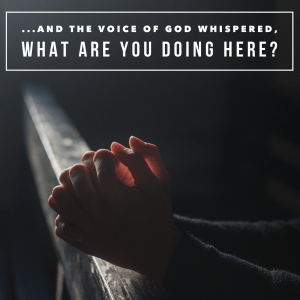
Then one of the devotions in the first week of the year reflected on how Elijah didn’t hear God in the storm or earthquake—but in the quiet whisper. And the whisper was a question, “What are you doing here, Elijah?”

Sitting in my quiet family room, holding the small book, I sensed my eyes filling with tears…and I heard God whisper, “Tina, what are you doing here?”

I didn’t have an answer. Still don’t. But you better believe I’ve been thinking about it. Even created the meme at the top of this blog.

The question is one of those kinds that when you say it you can put emphasis on a different word and change the meaning: What are you doing here? What are you doing here? What are you doing here? What are you doing here? What are you doing here?

After determining the direction, I felt compelled to be accountable. In the past I’ve lost interest and attention to my word/focus before I reached February. I might remember it later in the year—and have a few moments of guilt. I decided to not let that happen this year.

So every Monday I’m going to reflect on this with you, or at least with myself. I don’t know where it will go. Thankfully, I don’t have to…I’m just going to be obedient, and still, and listen for the whisper.

What are you doing here?

Lenten Thoughts: Naive

naive.jpg

On more than one occasion, I have been accused of being naïve, so I went and looked up the meaning.

According to dictionary.com:
1. having or showing unaffected simplicity of nature or absence of artificiality; unsophisticated; ingenuous.
2. having or showing a lack of experience, judgment, or information; credulous: She’s so naive she believes everything she reads. He has a very naive attitude toward politics.
3. having or marked by a simple, unaffectedly direct style reflecting little or no formal training or technique: valuable naive 19th-century American portrait paintings.
4. not having previously been the subject of a scientific experiment, as an animal.
I think I’m okay with that. Especially the part about not being used as a part of a scientific experiment.  But that wasn’t always the case.

naive1.jpg

Back in the mid-nineties, I decided to pursue my Doctor of Ministries degree. It seemed the logical thing to do. I applied to the denominational seminary of the church where I held my ordination. I completed the first seminar and was totally in love with being back in school again. I raced into the second course with all kinds of enthusiasm and anticipation.

naive2.jpg

Unfortunately, I ran headlong into a professor who rigidly held to a specific position and style of teaching. In his opinion, I wasn’t deep enough or reflective enough. I didn’t see things his way. I got the impression he wanted to fail me. I worked hard in the course, and tried to present my position and perspective. He told me if I hoped to advance in the program I would have to learn to “jump through the hoops” placed before me. I’m not a very good jumper, so I dropped out of the program.

naive3.jpg

As I have reflected on being naïve, I’ve changed my opinion. I began to see being the characteristic as not completely negative. Sealing the deal for me came when read Matthew 18. In that passage, it seemed to me, Jesus expected a certain level of naiveté from his followers. His response to the disciples when they argued about who was most important solidified this for me.

1At that time the disciples came to Jesus and asked, “Who is the greatest in the kingdom of heaven?”
2He called a little child and had him stand among them. 3And he said: “I tell you the truth, unless you change and become like little children, you will never enter the kingdom of heaven. 4Therefore, whoever humbles himself like this child is the greatest in the kingdom of heaven. (Matthew 18:1-4, NIV)

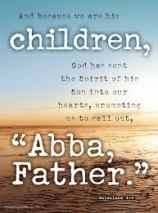
I’d rather be simple than cynical, or arrogant. I’d rather be real than artificial (reminds me of Paul’s instruction in Romans 12:9 that their love was to be without hypocrisy). I want to be credulous. I want to be ready to believe and to trust. I especially want the kind of relationship with the creator of the universe who invites us to be so close to him that we can call him, “Daddy.”

naive4.jpg