Soggy Pages

FC206BF1-92BB-470C-8B22-D4B87A1ECE50

“They” tell us to bleed on the page. That somehow if we will let our pain ooze out onto the pages we write that we will draw readers in—because everyone is bleeding and looking for healing. If we bleed, our words will release a relatedness that will draw others in.

I have no blood today…but I have lots of tears.

This morning my husband video called me. He was on his way to a friend’s house with our little dog. Our lives are in such a state of upheaval with me here and him there emptying our home of years of collecting, that the pup wasn’t getting the attention he needed or deserved. We came to the painful decision that he would be better off in a more attentive home. So Nelson called so I could say good-bye.

CC9CCB37-8B8E-425D-852A-88238474E6BA

I haven’t been able to stop crying.

The lesson I continue to learn: what’s best is not always easy. (The second lesson is to keep a tissue/hanky close by because tears aren’t the only thing that leaks.)

I came out to the patio to read and write after I ended the call with Nelson. I could barely see the iPad screen through my tears. My heart was aching and I just wanted pick up the stones in the yard and just start throwing them.

But I knew I couldn’t. Mom would have a cow. My mother cannot tolerate or handle intense emotions. I guess I know where I honed my skill at encouraging people to move beyond pain to healing. Like ticking items off an emotional checklist. Can’t let them get stuck in the anger…or the grief. Move along. Keep moving.

But today no amount of self-taught and practiced platitudes is unsticking me. I’m tired of rushing myself through hurt to healing.

I read a bunch of scripture. Nice as it was to know I wasn’t alone, that I could trust God’s presence and his promise, it just didn’t bring me the comfort I hoped for. The ache didn’t go away.

I feel the need to apologize here. I’m not meaning to be a Debby-downer (and sorry to all the Debbys in the world—you don’t deserve that moniker). I guess I’ve just realized that I had been pushing down all the hurt. Ignoring all the grief. Doing other stuff to keep from acknowledging how mad I am that I have to be the one making sacrifices…again.

Everything inside me wants to delete that last paragraph…at least the last line. It sounds icky. It feels selfish. I don’t want to be a petulant child, pouting about not getting my way. I realize being a servant comes with sacrifice. Today just brought it all to the surface as I saw that scruffy little face being driven out of my life.

I bristle when I hear people say, “God doesn’t give us more than we can handle.” I don’t believe it. I don’t agree. In fact, the Bible teaches just the opposite. There are two passages I need to be reminded of when life gets painfully soggy for me.

First, Paul writes to the Corinthian believers a very clear lament. You will find it in 2 Corinthians 1. He tells them that life was so bad, that he was “crushed and overwhelmed beyond our ability to endure, and we thought we would never live through it (2 Cor. 1:8b-9).”

Of course the main reason Paul was writing this was to share the lesson learned: that we are not to rely upon ourselves but God who will continue to rescue us…again and again and again.

In our pain, loss, and overwhelming times God is with us, he is reliable, he will rescue us.

But even if he doesn’t…that leads me to the second text. It’s tucked away at the end of Habakkuk’s prophecy. In Chapter 3 we find God getting good and mad. The prophecy scared even the prophet. But in the end his faith enables him to go to difficult place. He says: “For even if the fig tree doesn’t blossom and no fruit is on the vines, even if the olive tree fails to produce, and the fields yield no food at all, even if the sheep vanish from the sheep pen, and there are no cows in the stalls; still, I will rejoice in AdonaiI will take joy in the God of my salvation. Elohim Adonai is my strength (Hab. 3:18-19)!”

Even if everything I hope for is gone, or doesn’t happen, I will rejoice int the Lord. Several translations insert a “yet.” It’s the same concept as nevertheless. That’s what Shadrach, Meshach, and Abednego said when they faced the fiery furnace. They fully believed God would save them, but even if he didn’t they still believed, and wouldn’t change anything. It’s the same way Jesus prayed in the garden: “Is there not another plan? Nevertheless, not my will but yours be done.”

These are overwhelming days. Loss comes in waves. We will have our soggy days. We don’t have to ignore or deny our hurt. Jesus felt the pain in the garden so intently that Luke says he sweat drops of blood. Jesus never faked “fine.” When he was sad, he wept. When he saw injustice, he got angry.

Feel the anguish…but keep your “nevertheless” (and a box of tissues) close. That’s how we find healing. That’s how we keep from being stuck.

In the Midst of the Storm

65BA60F2-D2D3-4C94-B38F-4DF6C62A7307

I came out to the patio to write. I swept the patio. I fussed around the table. I decided to work on worship music for tomorrow’s online service.

I was doing everything but writing.

I pulled up the song, “Fear No More by building 429.” I found something to write about. I love this song. It fits my current situation. The lyrics of the song contain an image of Jesus holding us in a storm not of our own choosing. “This isn’t what I planned…” Chaos is all around but Jesus is with us in the storm.

As I listened my mind drifted to the passage where Jesus and the disciples are in a boat and a strong storm happens. Mark records Peter’s recollection: On that day, when evening had come, he said to them, “Let us go across to the other side.” And leaving the crowd behind, they took him with them in the boat, just as he was. Other boats were with him. A great windstorm arose, and the waves beat into the boat, so that the boat was already being swamped. But he was in the stern, asleep on the cushion; and they woke him up and said to him, “Teacher, do you not care that we are perishing?” He woke up and rebuked the wind, and said to the sea, “Peace! Be still!” Then the wind ceased, and there was a dead calm. He said to them, “Why are you afraid? Have you still no faith?” 41 And they were filled with great awe and said to one another, “Who then is this, that even the wind and the sea obey him?” (Mark 4:35-40, NIV)

Jesus is not holding the disciples when the storm crashes in on them, and they are terrified they are going to die.

Jesus is there. He’s been there all along. He has the power to still the storm around them…and within them. Their fear brought them to Jesus, but not for an answer. They came accusing him of not caring. They are angry because while they’re consumed with and by their fear Jesus is curled up, cozy on a cushion. They are infuriated at his selfishness: this is no time to sleep, man! Do something for us. NOW!

In Mark’s account, Jesus rebuked the storm. What an object lesson. Storm, be at peace. Be still. Jesus may have addressed the storm, but his message was for the disciples. And it’s for us also.

Do you feel like there’s a storm all around you? Are the walls closing in? Do you fear for your life…or your way of living?

Here’s my confession: I’ve been really mad at God. Life was going pretty sweetly for me. I was achieving goals. I was about to start my D.Min (or finish it). Nelson was finally getting some of his medical issues addressed. We were happy. It was sort of like a Sunday boat ride on the lake on a wonderful summer day. Weather perfect. Floating along. Cozy. Relaxed. Happy.

Then bam. And nothing was comfortable. I couldn’t find happy anywhere on my radar. Ripped from the familiar. Life as I knew it…as I wanted it…was gone.

And this isn’t the first time in my life. I don’t want to re-rehearse the litany of what I saw as injustices perpetrated by God upon me. Why give it to me just to yank it away?

Selah. (Period of reflective silence.)

Job: shall we take the good and not the bad?

Paul: I have learned whatever situation I am in to find contentment.

Jesus: I’m right here. Be at peace. Be still.

Paul again: God puts us right where he wants us. (1 Corinthians 12:18)

Me: okay. I will trust that you are with me—even in the storm. I may not be in school for my D.Min, but I have a lot to learn. Right here. Right now. (That’s my prayer, so Amen.)

Pleasing My Father

E54EBB88-E0C8-4FEE-B1A7-18A07D2E5861

I went out to get the mail. I knew it probably wouldn’t be there, but I needed some fresh air…and steps…always steps.

It wasn’t there.

I wasn’t ready to go back into the overheated house. (One of the challenges of living with an older person with no insulation on her bones.) I knew that older people kept their homes warmer. I just wasn’t ready to be in a house where the furnace ran most of the day. The air was warm and sometimes hard for me to breathe.

Fresh air would do my brain some good. I sat in my chair and soaked in the sun and bird songs around me. My eyes closed in a moment of sweetness.

As soon as my eyes opened the sweetness was gone. No longer did the bluest sky fill my vision. Nope. All I could see was the dirt and debris. And the song of the birds was replaced by my father’s voice. I was transported back to high school, I found Dad in the garage cleaning and grousing. Dad took great pride in his well manicured lawn and clean garage.

The image barely passed and I found myself looking for a broom and dust pan. Items found, I quickly set about the task of sweeping the garage, porch, and front walk.

Sometime around my third pile of sand and stuff, I thought, “Dad would be pleased.”

My dad died in 1989. I never felt like he was proud of me. Not proud that I was fourth runner up to Miss Teenage Columbus. Not proud that I was a First Class Girl Scout. Not proud that my class elected me to student council as I was entering High School. Not proud that I graduated in the top 10% of my class of over 30. Not proud of anything I did, or who I was.

Once he told me I’d never write anything anyone would ever want to read.

And yet, here I was sweeping out a garage in a house he never lived in…hoping he would be pleased with me, with the job I had done, that I’d even thought to care.

When I was all finished I sat back down in my chair. I felt a brief wave of sadness flow over my heart. But just as quickly as it was gone, I felt a warmth—the warmth of a smile. In that mysterious way of knowing, I knew it wasn’t a smile from my dad. This smile came straight from my Holy Father. The One who knows me, loves me, walks with me, stays right by my side. The One who created me, sustains me, encourages me, strengthens me. The One who is always proud of me.

My name is written on his hands.

So is yours.

DDC5D52C-C446-4B30-8D1D-102B2F0C4BFF

Last Words…

(Once again going through writing files. Finding this the day after the tragic helicopter crash that killed nine people in California, including Kobe Bryant and his daughter, just seemed serendipitous. That and realizing how sick my mom was last week, well, I just want to encourage us to say those things that need to be said to find healing, comfort, and closure.)

My dad died in August 1989. He had cancer of the bladder that metastasized to his lungs, kidneys, and finally the brain. In July, he had a seizure, and while his body kept functioning, my dad was gone. I came home while he was still in the hospital. I was sitting with Dad, giving Mom a break, when the fog in his brain lifted. He began speaking clearly and using familiar hand gestures and expressions. It was so good to see him. He started to make me a diagram on the tablet I was writing on. About thirty seconds into what he was explaining his writing and his speech began to slur, and he was back in the fog.

A few weeks later, we received a call from Mom. The hospice nurse had told her to gather the family. They didn’t know if he would even make it through the day. It was the quickest trip from Kansas City to Columbus we ever made. That was Friday. Dad lingered until Wednesday. Each of us had our time by his bedside. We all said lots of things, but I don’t know what he heard. More than anything I said, what I wanted was to hear him say he loved me…one more time.

Last words. They hold such power and weight. Jesus knew that. As he came to the end of his time, he gathered the disciples close, and gave them his undivided attention and teaching. As I think through those lessons I’m thankful Jesus’ last words to Peter weren’t about his betrayal, but were an instruction to feed Jesus’ sheep.

Last words. Here’s the problem with them. Jesus knew when he was going to die. He had the opportunity to plan out those final meetings with the people who mattered the most to him—an advantage not many of us have. We rarely have a clue what could happen in a day. This was driven home to me when the husband of a friend had a colonoscopy done, and two weeks later he was gone. Or when my fifteen year old nephew fell off a cliff at church camp and died. Or when one month after becoming friends with a precious, encouraging woman, she was killed in a head on automobile accident.

So here’s what I think the challenge for us is. We have to learn to somehow live as if all our words were our last words. As if all our lessons to our children were the last lessons we were going to give. Would it make a difference? Hopefully, there would be more love and grace. When asked if he knew he only had a short time to live if he would change anything, John Wesley replied he would not, implying he was already living with a sense of the importance of each moment. Are we there yet? I know I’ve got room for improvement.

In Ken Gire’s book, Reflective Living, he discusses the Shema. He describes how important this was to the Jewish believer. It would be the first thing they said every morning and the last thing said every night. Their last words before they died would be the Shema: “Love the LORD your God with all your heart and with all your soul and with all your strength (Deut. 6:5, NIV).”

If we were living this kind of ALL consuming love, perhaps we would come to say all the things we need to say while we’re alive. I believe living all out this way will make Jesus’ last words more real to us, and help our words, first and last, count more now…

…and in the end.

And Be Thankful…

(I’ve been staying with my mom for a couple weeks. She is recovering from a nasty bout of pneumonia. This morning we were having a conversation about worry, control, and acceptance of the new normal. After our talk, I found this piece in my to be finished file. The message seems timely…hope it is for you, too.)

Have you ever considered what it must have been like to be Adam and Eve? How perfect their life was. How every one of their needs was met before they could ask. How they had no questions, because there was no need. How every day they walked with God—they were completely in his presence.

How cunning of the Tempter to challenge their naïveté, their simple way of life.

He challenged them on the only front he could: their desire for more, their sense of entitlement. And they bit and bought his deception, and that introduced the problem of dissatisfaction to the whole human race.

We are entering the season of the year when we focus not only on being thankful, but a time when we contemplate the giving of the greatest gift—God himself coming as a baby—born that man no more may die.

Recently, I spent some time in my Sunday message addressing how meekness is not weakness. I suggested the definition: Meekness is therefore an active and deliberate acceptance of undesirable circumstances that are wisely seen by the individual as only part of a larger picture. 

I think Paul must have understood this. 

To the Corinthian church he wrote: Three different times I begged the Lord to take it away. Each time he said, “My grace is all you need. My power works best in weakness.” So now I am glad to boast about my weaknesses, so that the power of Christ can work through me. That’s why I take pleasure in my weaknesses, and in the insults, hardships, persecutions, and troubles that I suffer for Christ. For when I am weak, then I am strong (2 Cor. 12:8-10, NLT).

Eugene Peterson in The Message gives us this paraphrase of the same passage: I was given the gift of a handicap to keep me in constant touch with my limitations. Satan’s angel did his best to get me down; what he in fact did was push me to my knees. No danger then of walking around high and mighty! At first I didn’t think of it as a gift, and begged God to remove it. Three times I did that, and then he told me, My grace is enough; it’s all you need. My strength comes into its own in your weakness.

Once I heard that, I was glad to let it happen. I quit focusing on the handicap and began appreciating the gift. Now I could see Christ’s strength moving in on my weakness. Because of this shift in thinking, I take limitations in stride, and with good cheer, these limitations that cut me down to size—abuse, accidents, opposition, bad breaks. I just let Christ take over! And so the weaker I get—the less control I try to muster, the stronger I become.

To the Colossians Paul also wrote: And let the peace that comes from Christ rule in your hearts. For as members of one body you are called to live in peace. And always be thankful. Let the message about Christ, in all its richness, fill your lives. Teach and counsel each other with all the wisdom he gives. Sing psalms and hymns and spiritual songs to God with thankful hearts. And whatever you do or say, do it as a representative of the Lord Jesus, giving thanks through him to God the Father (Colossians 3:15-17, NLT).

And to the Thessalonians, in his final advice section, he pens: Be thankful in all circumstances, for this is God’s will for you who belong to Christ Jesus (1 Thessalonians 5:18, NLT).

James got it too: Dear brothers and sisters,[a] when troubles of any kind come your way, consider it an opportunity for great joy. For you know that when your faith is tested, your endurance has a chance to grow. So let it grow, for when your endurance is fully developed, you will be perfect and complete, needing nothing (James 1:2-4, NLT).

Our strength comes from being grateful that God is in control. We can rely on him. The recognition of our inability to control things is where our weakness meets up with God’s strength.

This is where I find confidence to declare with Paul, that we can do all things through Christ who strengthens us.

It’s not a matter of “doing” everything. 

I can’t do everything, or every thing.

But I can face what ever comes my way.

Because he promises in all things we are—or can be—more than conquerors.

So when the tempter slithers up beside and tries to convince you that you don’t have enough, or the best, or less than someone else—call him what he is: a big fat liar.

The LORD, he is your shepherd…and you have everything you need…

…and be grateful.

Brain Protection

I have learned to take critique. Thank you, Word Weavers. I have actually gotten to the place with my writing that I seek out the input of others to make me a better writer.

Sadly, this openness to input and constructive criticism had not reached other parts of my life.

Not long ago, the chairman of the commission I’m directly responsible to informed me that I need to cut back on the length of my sermons, and stick to my manuscript so that I don’t get off topic so much.

I love preaching. And I was under the impression after only glowing comments for the past four and a half years that the congregation was pleased with my style and delivery. I make a point of watching the crowd and thought I was reading them well.

Guess not.

I began to feel like I used to when I got job evaluations. The whole eval could be positive, but if there was one point where I perceived I received a negative “grade” that’s all I could focus on. And I always took it personally. That’s what coming from a shame-based family will do for you—at least it did for me.

I complied. I became a clock watcher. I finished in time for the closing hymn—whether I was done or not. I stopped short of saying, “Well, I can see we’re out of time…” I read the manuscript and held onto the sides of the pulpit to avoid walking away from the script and getting lost in my illustrations.

And I went home and cried every Sunday. And I sought solace in food.

Finally, this last week, my husband said, “Enough.” He went on to describe the disturbing depth of my funk, suggested a few options, and instructed me to pull out of my head.

In case I’ve never mentioned it here…I really appreciate this guy.

Then on Monday I pulled up several posts from my dear friend, Debby Berry. She’s going through a really tough time and is blogging some really powerful stuff. I plugged into her posts on Philippians 4:8 and what we need to be feeding our mind.

And a light came on in my brain. And it continued to shine brighter and brighter as I got ready for a bike ride. I remembered one of my favorite stories.

A long time ago, I read about a couple little kids who were going to ride their bikes. One kid showed up wearing his helmet. The other kid didn’t and he started teasing his buddy about his “baby hat.” The helmet wearer responded by asking why his friend’s parents didn’t make him wear one. His buddy had no answer. Helmet boy, shrugged his shoulders and replied, “I guess my mom loves my brain more than yours does.”

And I heard the sweet whisper of God: I love your brain. We need to work on your thinking.

Couldn’t argue with that.

So I put the bike on the rack and headed toward my favorite trail.

Half way down the road (flying down the interstate) I realized I forgot my helmet. I don’t ride without my helmet. Well, that’s not exactly true. This summer I got all the way (21 miles from home) to the trail and realized I’d left my helmet by the door. I opted to ride anyway, but the guilt each time I passed a child on their bike, riding with their parents, and wisely wearing their helmets, was huge. I kept wanting to shout an apology: “I’m sorry. I know I’m being a horrible example. Keep wearing those helmets kids!”

Right then, I decided I was stopping in at the bike shop near trail before I started my ride. I was hoping they rented helmets, or I’d be buying a new one. I got there at 9:40 and they didn’t open til 10. Wait? Absolutely.

When the door was unlocked, I went in and explained my dilemma and need to the owner who promptly handed me a helmet and told there was no charge.

And I heard that sweet whisper again: I love your brain. Ready to think better?

My favorite thing about riding is how close I feel to God as I pedal away. I found that to be especially true on this ride. I left my funk somewhere out on the trail. I came up with several creative options to my preaching critique—that’s what critique should do. Now we’ll implement them and see what works.

In case you haven’t been told lately, God loves your brain too! Be careful what you feed it.

Wading in Puke

The weekend before this one just past my husband and I took turns with the flu. Kindly, he went first. Not so kindly, he made a couple unsuccessful trips to the bathroom, leaving behind a very unpleast mess to clean up. He managed to spew on every wall and fixture.

Fast forward to this past weekend. Saturday night our thirteen year old grandson went to bed early, complaining of a queasy stomach. He made one trip to the bathroom, seemingly emptying his belly completely, he flushed away, and put the lid on the toilet down (as is the rule at his house). The problem came when on his second trip he could not get the lid up quickly enough or even have time to turn and aim for the sink or tub.

May I just say, I have never seen such a mess, in either quantity or dispersement. And I have no words for the smell.

Then, I was awakened Sunday morning by one of dogs wretching off the foot of our bed. He made a rather thorough mess of things, too.

All I could think was, “Really, God. I need this, why?”

This morning, after dropping my grandson off at school, I headed to my favorite coffee spot and writing place. I no sooner had my coat off when my phone rang. Sigh. The grandson. What did he forget this time?

When I answered the phone, I knew I was on speaker—I could hear the laughter and noise in the background. Through laughter my grandson finally asked “Mema, legit, did I puke all over the bathroom this weekend?”

“Yeah, buddy, it was the worst puke I’ve ever cleaned up.”

“Thanks. See…” And the line went dead as hysterical laughter broke out.

Only a group of 13 yr old boys could enjoy a story like that and be congratulatory. He was so proud of himself. And for one moment I forgot how awful a mess it had been to clean up.

I will confess, I was laughing, too. I quickly texted his mother and let her know what a hoot her son was. She responded right back a message filled with laughing emojis. He had been bragging to his gamer friends about the event as well.

The whole thing reminded me of a conversation I had with Eddie Jones (writer and CEO of Lighthouse of the Carolinas at a writers conference. I was telling him how much I appreciated his books for middle grade boys. He waxed a bit philosophical, and then said making sure each story included farts, puke, and practical jokes was his ticket to success. “You have to know your audience.”

So, dear audience, what can we take from this gross, yet for some hysterical set of circumstances. I can think of three things.

First, puke happens. It’s not pleasant in the moment, but we always tend to feel better when it’s over. Sometimes we need to let the roiling fear, anger, or grief out to feel better and be able to move on.

Don’t take yourself too seriously. The laughing group of thirteen year old boys reminded: you can even laugh about the grossest stuff of life. There will always be enough sadness to go around, but learning to find the humor is a solid way to pull yourself out of the downward spiral sadness tries to suck us into.

And remember to thank (profusely) the person who has to clean up your mess. Over and over my grandson apologized to me. And over and over I tried to assure him that I knew he didn’t plan on the mess. I believe his contrite and sincere apology was what enabled me to laugh after his verification phone call. His previous appreciation for what I endured in the extensive clean project enabled me laugh along with him and his buddies instead of thinking that he was making fun or laughing at me.

Who knew you could learn so much the negative consequences of the stomach flu?

But really, I think I learned enough to satisfy me for a very…very long time.

Holding My Tongue

7D9F2718-F9E4-48D2-B8F8-EEF33CC24C84

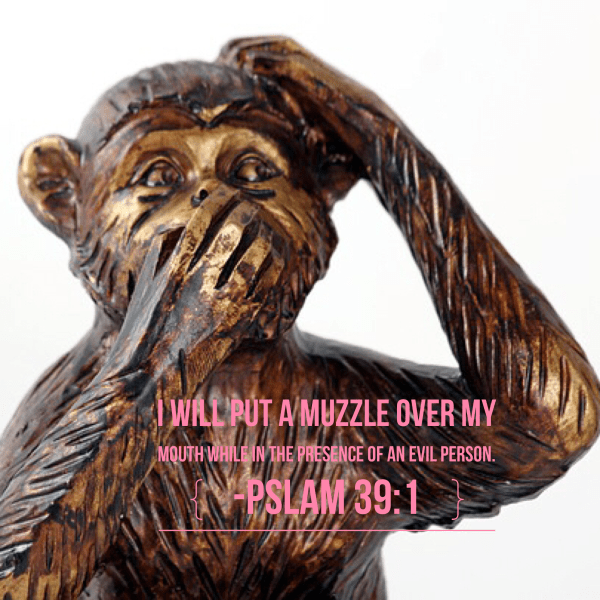
In Psalm 39, David addresses an interesting choice he made: to keep quiet, to hold his tongue…to not argue back.

Imagine that…Selah.

We have become a nation of “right fighters” (to use a well-worn Dr. Phil-ism). We argue for argument’s sake. We chose to be right, no matter how ridiculous we sound or how much damage it does to our witness…or our relationships.

David probably felt he had every right to speak. After all, he WAS God’s chosen one. But he opted to put a muzzle on himself.

The problem was, it didn’t solve the problem. What he wanted to say just built up inside until he was ready to burst. He saw issues, problems and he became frustrated by not addressing them.

But when he was at his bursting point, instead of exploding on the person creating the issue, having the problem, making the mistake, or whatever…he didn’t vent or rant all over them. He didn’t go to social media and spill his guts. He didn’t dump on a friend.

No. He turned to God. “I felt a fire burning inside, and the more I thought, the more it burned, until at last I said, “Please, LORD, show me my future (vs. 4-5a).”

He took his anger directly to the place where it could do the most good and then rather than focusing on someone else, someone who he couldn’t change—no matter how much he argued—he pleaded with God to better understand himself.

Imagine that…Selah.

As a pastor, I have talked and counseled with many people who are angry…typically with the behavior or choices of someone else…sometimes with God. And they stew and stew until they finally blow. Usually the eruption ends up falling upon someone totally innocent and unworthy of the volcanic spewing.

When I query as to whether they consider taking the matter to God, they are shocked and appalled. In their minds they have “protected” God from their anger…as if that’s possible and as if God couldn’t handle it—he’s just so fragile, you know?

God’s not fragile. He’s also not afraid of our anger. Paul clearly instructs the Ephesians to “be angry, but sin not.” Remember, Jesus got angry on the more than one occasion—just ask the money changers in the temple, or the Pharisees.

Hold your tongue when you can. Nothing is gained by arguing for argument’s sake. And before you dump your anger on someone else, try taking it to God. He can handle it.

Wednesday Word: INSPIRING

E1F0E54F-2960-4E8D-A1C6-B46BCF05728C


These words are meant to serve as an encouragement. When I think of inspiring I think of people and places, times and events. Let’s think about the people who inspire us.

Who inspires you and why?

Who are the people across your life who have beaten the odds, strived for excellence without necessarily seeking attention, or persevered and prospered when everyone else gave up?

Can you see them? Have you told them? Is their picture on the fridge or where you can see it so that when you want to give up their memory or presence spurs you on one more time.

We need these people in our lives. Examples of what can be…what we need to be.

And we need to be these people.

Don’t get all false modest on me, thinking there’s nothing in your life that could inspire anyone. You may not be looking to live an inspiring life. You may be wondering if you’ll just make it to lunch—but the way you do even that might be just the inspiration that someone needs to not give up.

Here’s the truth: people are watching. You know that because you watch others.

Be someone’s inspiration today. Face down your giants. Live large though you’re shaking in your shoes. Don’t let anyone—ANYONE—trample your dream. Do what others say can’t be done. Love. Forgive. Live.

You can do this. We can do this together.


Wednesday’s Word: Awe

F36968A3-779F-40D0-8F12-95B2CC74E75B

So the plan for this weekly post is to have an encouraging word for those extra long days and weeks that weigh heavy and are discouraging.

Today’s word is a great word for that purpose. So many days we get tripped up by the mundane, sabotaged by the pain, or overwhelmed by the struggle. We’re taken down by those things because we lose perspective: the ability to see above and beyond.

A scripture that lifts me to a place of awe is found in Isaiah 40:

28 Do you not know?
    Have you not heard?
The Lord is the everlasting God,
    the Creator of the ends of the earth.
He will not grow tired or weary,
    and his understanding no one can fathom.
29 He gives strength to the weary
    and increases the power of the weak.
30 Even youths grow tired and weary,
    and young men stumble and fall;
31 but those who hope in the Lord
    will renew their strength.
They will soar on wings like eagles;
    they will run and not grow weary,
    they will walk and not be faint.

God can give us the ability to soar above…and that’s pretty awesome. He keeps his promise, gives us everything we need—including the ability run, or  the strength to just keep walking.

That’s awesome and amazing.