Lenten Thoughts: Remembering

remembering1.jpg

In the movie “The Sound of Music”, when Julie Andrews’ character is comforting the children in the middle of a horrific thunderstorm, she sings a song. Don’t they always when it’s a musical? The song she uses to bring them comfort is a recounting of all her “favorite things.” Maybe you remember a few: raindrops on roses and whiskers on kittens; bright copper kettles and warm woolen mittens. She simply remembers her favorite things, and then she won’t feel so bad.

remembering2.jpg

Remembering. It’s a biblical principle. In the Old Testament God’s people are told to make a pile of rocks, and the children are to ask why are they there. The adults are then to tell the story of God’s protection and provision. This way the story would not be lost from generation to generation.

I read an article this week that made a very bold claim—or at least I thought it was bold. The author stated we forget because we anticipate we are going to forget. And if I could remember what magazine it was in, I would put down the whole quote. In essence: we forget because we don’t remember.

Perhaps that’s why there are so many references to remembering in the Bible, two hundred thirty three according to biblegateway.com.

remembering3.jpg

Memory is a fickle thing. In my work with my little lady who had Alzheimer’s, I marveled at how she wasn’t able to remember our immediate conversation but she could recount wonderful stories from her youth. She could tell you her recipe for homemade bread, but as she made it she couldn’t recall if she put in the yeast.

One day she had been in her room for an unusually long time, so I quietly peeked in the door to check on her. She was sitting on her bed by the bedside stand with her Bible open on her lap, her fingers running over the page as she read and reread Psalms. It reminded me of a time when I visited a woman in the hospital who was very close to death. Her lips were moving, but no sound was coming out. I leaned in close and heard her softly repeating the Lord’s Prayer. She was no longer conscious in this world, but her spirit was totally in touch.

Have you watched the news lately? It’s not for the faint of heart. There isn’t much “good” news being report. So we need to remember. What has God done for you, now or in the past? Where have and do you see his hand? Life is going to get harder. So unless we become more intentional in our remembering, it will be very easy to forget.

remembering5.jpg

Lenten Thoughts: Noseblowers

noseblower1.jpg

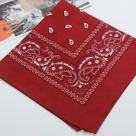
My grandson was trying to get my husband to give him all his bandana handkerchiefs to play with, but he didn’t have the correct name for the item in his very extensive three year old vocabulary. He started up the stairs to retrieve them by himself when he decided to enlist my help to get the “noseblowers.” We couldn’t help but laugh.

He called the item by its function. Makes pretty good sense. We find all kinds of reasons to identify things and describe stuff. In the very early recounting of Creation, Adam is given the daunting task of naming all the animals. I sure would like to know how he came up with hippopotamus.

noseblower2.jpg

My mother swears I created the word “humongus.” (She thinks I’m so creative and that’s one bubble I chose not to burst.) But since then we’ve come up with ginormous, absatively, and oppersponsities. (My spell checker is giving me fits right now—I’m afraid I may run out of red ink.)

Making up words is obviously not a new thing. When I studied New Testament Greek, I was always looking for the 1-1 words. These were words that were used one time by one writer. They were unique and purposely place to catch our attention. They were words “coined” or used by that writer to express something new or different, or something old in a new way. Now when you think of this, it makes a lot of sense since everything was new since Jesus.

Paul was especially good at these word creations. He would be trying to describe the enormity of God, or his love, or our responsibility and he would just start shoving words together to emphasize the “gigundousness.” Paul was pretty intense about his faith. He wanted everyone to get it. And he used and created words to create interest and attention—and believers.

“Noseblowers” caught our attention and we laughed. Grandson loved the attention and we played with handkerchiefs for over an hour. Even through the games and laughter I found myself thinking about the words I use. In Paul’s instructions to young Timothy (1 Timothy 4:12), the first thing listed for setting the example is in speech. God spoke and the world came into being. Words carry a lot of power.

We can have a lot of fun with words. We can also do a lot of damage. What will your words do today?

noseblower3.jpg

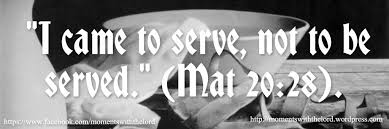
Lenten Thoughts: Service

servantheart3.jpg
I’ve always thought that I had a servant’s heart. I’ve gone so far as to consider getting a personalized tag for my car with the Greek word for servant. I would and will do whatever I’m asked. I look for ways to make the lives of others more comfortable and enjoyable. Today as I worked with my little lady with Alzheimer’s, I decided perhaps I needed to rethink this.

As is sometimes the case, she was not in a very good frame of mind when she emerged from her bedroom. She immediately began to fuss and grouse and order me about. And it had an instant effect on my spirit. I wanted to point out all the things I do and justify myself. Not a very good servant response.

servant heart4.jpt.jpg

What I decided was: serving is easy when it’s easy to serve. As soon as it gets difficult or dirty, we find ways to back out. And if we don’t turn away, our attitude slips a little.

Here’s Paul’s take on servanthood: 1If you have any encouragement from being united with Christ, if any comfort from his love, if any fellowship with the Spirit, if any tenderness and compassion, 2then make my joy complete by being like-minded, having the same love, being one in spirit and purpose. 3Do nothing out of selfish ambition or vain conceit, but in humility consider others better than yourselves. 4Each of you should look not only to your own interests, but also to the interests of others. 5Your attitude should be the same as that of Christ Jesus. (Philippians 2:1-5a, NIV)

I think that part of what I learned putting these verses together with my run in the other morning is that it’s so not about me. My feelings were hurt when I felt unappreciated. Serving others can’t depend on their expression of gratitude. Jesus told his disciples if they were working for the pat on the back of others then that would be the sum of their reward. What we need to motivate us is not the praise of people, but the well done from God.

servant heart2.jpg

Jesus could teach this because he understood it. It was pretty clear that Jesus didn’t back away when things became difficult or painful. His service took him willingly to the cross. And that’s whose mindset we are to emulate.

I have a lot to learn about being a Jesus kind of servant. I think I’m going to skip the license plate—probably even the t-shirt.

servant heart.1.jpg

Lenten Thoughts: Mindfulness


I read an article in Prevention magazine several years ago about the benefits of mindfulness. Did you know:
-A study showed in 140 binge eaters mindfulness reduced binging 75%.
-Mindfulness eases anxiety by 44% and depression by 34% while increasing immunity.
-Mindfulness improves physical functioning and reduces pain.
-Mindfulness results in significant improvement in memory.
-Mindfulness strengthens relationships. (Prevention Magazine, January 2008)

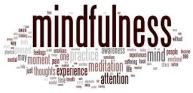
mindful wordcloud.jpg

Pretty impressive. Pretty good reasons to consider being mindful. What does it mean? According to dictionary.com, mindfulness is defined as: attentive, aware, or careful. I am of the opinion that this word, concept and practice, is very biblical.

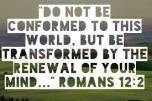
renewal of your mind.jpg

Paul told the Romans to be transformed by the renewing of their minds (12:2) and directed the Philippians to think on what is “whatever is pure, whatever is lovely, whatever is admirable—if anything is excellent or praiseworthy” (4:8). A search of “take care” brings up 117 references in the Old and New Testaments.

pay attention.jpg

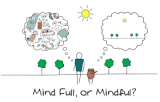
So it behooves us to “pay attention” in life. What have you been noticing as you race through life? What have you heard? What have you felt? There was a tissue commercial where a woman was going through her day with a “touch, touch, touch, touch…feel” experience. The point was: we bump through life barely aware of the things we touch and that touch us. When the woman finally came across the best tissue, it caused her to feeeeeel something more deeply. We can know that kind of depth as we come into the presence of the Almighty. Talk about feeling!

In Psalms we find the assurance that God neither slumbers nor sleeps. David is overwhelmed by God’s attentiveness and questions in Psalm 8: who are we that you are mindful of us? Nothing happens in our lives, but God is aware. He knows when we are up all night. He knows when our job is about to phase out. He knows what the doctor just told us. He knows. And he is mindful, attentive and caring.

Today, don’t just bump mindlessly through your appointments, contacts, or even your shopping. Yesterday, we were invited to look. Now, we are invited to be mindful of the one who is mindful of us.

mind full.jpg

Lenten Thoughts: Look and See

Body measuring.jpg

When I worked at Curves, one of the first things we did with new members (after we oriented them to the whole program) was complete a figure analysis. Basically, we had them mount the dreaded weight determiner and grab the tape measure to find out the sum total of their girth. Did that sound ominous? It was supposed to. The dread that most of those women felt in that moment is colossal. They have spent so much time and energy avoiding the truth, that it is a very scary and humbling task to meet it—and in the presence of another person, yet!

avoiding the mirror.jpg

Perhaps you’ve never thought of it this way, but it’s very easy to not see what we don’t look at. How many of us read our food labels? Before signing off on something, do you read all the fine print?

The list could go on and on of things external, but what about things within?

On the one hand, we could consider all the health signals that we’ve ignored, the doctor’s visits we’ve postponed because we didn’t want to hear what they had to say. Then there’s the stuff of spirit and emotions we’ve opted not to look at either. The AA people understand the importance of that honest self-inventory.

James invites us to the mirror: 22 But don’t just listen to God’s word. You must do what it says. Otherwise, you are only fooling yourselves. 23 For if you listen to the word and don’t obey, it is like glancing at your face in a mirror. 24 You see yourself, walk away, and forget what you look like. 25 But if you look carefully into the perfect law that sets you free, and if you do what it says and don’t forget what you heard, then God will bless you for doing it. (James 1:22-25)

So here’s your homework. Yes, homework.

Carve out a few minutes from your very hectic schedule—that busyness is part of the problem. We stay busy to avoid having to give ourselves—and God more than a passing glance. You could sit at a table with pen and paper or you could stand in front of a full-length mirror. Do what works for you. But do this: ask God what you need to see. Ask for his forgiveness for avoiding, denying, and running. Stay long enough to hear his answers. Let him tell you how wonderful you are and how much he loves you. Then commit to giving him more than a passing glance.

Take that kind of time and you won’t forget it—or regret it.

fearfully made.jpg          gods masterpiece.jpg

Lenten Thoughts: Restore

(This reflection was written in 2009.)

day old.jpg

A few days ago, my husband and my grandson went grocery shopping. One of their favorite stops is the “day old” cart by the bakery. The grandson spied an individually wrapped cornbread loaf. He had to have it and grandpa obliged. The problem was that by the time they got to the car the bread had been pulverized in its wrapper. Abandoned as inedible, the crumby remains sat seemingly unwanted on the kitchen counter for a couple days.

pot of chili.jpg

Fast forward a few days, my wonderful husband and cook made a pot of venison chili. On a whim I packed the crumby remains to eat for lunch with my chili. When it came time for lunch I opened the wrapper and dumped the crumbs into my chili. As I ate, I think I might have purred, it was just that good.

I had come very close on a couple occasions to throwing out the crumby mess. What was I going to do with them? They no longer appeared to have any purpose. They didn’t look good. I imagined that their inability to seemingly live up to their original intended use made them useless. Now isn’t that just the way we think?

trash bin.jpg

How many people have we almost thrown away because they no longer appear to be living up to their purpose? How many lives wait desperately to be reclaimed and restored but experience none because their lives are messy?

A few years ago I interviewed for a position with a local ministry. One of the board members conducting the interview, who was aware of the “messiness” of my own life, asked if I had been restored. It was a tough question to answer then. It still is. I know I’ve been redeemed—that was God’s work. The rest, well, it may take more time. But it will be as sweet as the cornbread in my chili.

God restores.jpg

Lenten Thoughts: Excuses

what's your excuse.jpg

When I worked as a Fitness Tech at Curves, The Workout Place for Women, I heard all kinds of excuses from the women trying to justify not taking or making time to exercise. I knew most of the excuses, because I was already pretty good at using them myself. But aren’t we all?

download.jpg

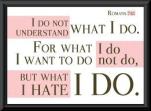
Paul paints a pretty clear picture of the human dilemma in Romans 7: that which I should not, that do I do. Personally, He wanted to do better, knew he needed to better, even knew what he should do, but more often than not, he give in to his weaker nature. He felt wretched. Sound familiar?

snow through window.jpg

I remember waking one morning, early, at 5:00 A.M. to go do my workout. I peeked out the window. The sidewalk and road were covered with snow.  It had been an unusually snowy winter and I was beyond ready for spring. I’ve never liked driving on snow, and would find any number of excuses to not do so. The excuses began formulating in my brain as I contemplated going to workout.

no excuses.jpg
I had a choice to make. Would I grab an excuse and crawl back into bed for an extra hour of sleep? Who would really blame me? I mean, exercising at 5:00 A.M. is crazy enough, why risk an accident in the snow to do something crazy? Or, would I pull on my sweats and head to the car? I opted for the car!

Now there is not anything necessarily noble about going to exercise at 5:00 A.M., but there is something worth rejoicing about when we don’t let excuses keep us from doing and being what we should or can be and do. We don’t use excuses just to avoid exercising and eating right. We use them to justify poor relationship decisions, cheating at work, speeding down the highway, fudging on our taxes. And we use them with God.

I had a good workout that morning. Physically, mentally, and spiritually, I’m glad I went. As I drove home that day, I thought about how the rest of my day might go. Some of it I could plan for, but I knew things could pop up unexpectedly. I determined right then to have an excuse free day: no excuses physically, mentally, or spiritually. As I recall, I felt freer and got a lot more accomplished—it was easier to get things done rather than hunt for excuses to not.

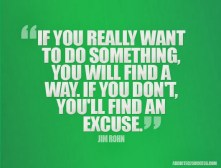
We talk about all the things we’re going to give up for Lent. Here’s an idea: let’s give up making excuses to avoid doing the things we know we need to do, or the things that will take us out of our comfort zone. We might find a whole new kind of energy. And if we put enough of those days together, we could create a whole new habit—and a positive one at that!

Jim-Rohn-Picture-Success-Quotes.jpg

(I’m still checking on the above quoted motivational speaker, Jim Rohn, so the jury is still out on whether I buy in to all his stuff. This quote, however, hits the nail on the head for me.)

Owning Up

empty nest.jpg

Being empty nesters has some wonderful advantages, but a few disappointments I hadn’t considered. One of the things that has changed is the ability to blame. For example, if the refrigerator door is left open or the last ice cube taken—it was probably me. And I’m the one who left less than a serving in the bottom of the cereal box.  The clearest example came, however, when I realized I had forgotten to replace the empty roll of toilet paper. I had no one to blame but myself.

raised hand.jpg
Instinctively, right before I dug in the cupboard to retrieve a new roll, I raised my hand. Do you remember how we used to do that when we played on the basketball courts of our childhoods? When we committed a foul we would raise our hand signifying taking responsibility for the transgression: “I did it. It’s on me.”

argue call.jpg

The same thing used to happen in professional sports. Not so much anymore. No, nowadays more often than not, when a foul is called by the referee the players go into some display of blaming others—even in the most obvious and flagrant of cases. Bottom line: people don’t accept responsibility.

This caused me to pause and reflect for a bit on the areas of my life where I have preferred to blame-shift spiritually. Over the years it’s been “easy” to point the finger at my parents or the fact we moved so often, and many other things. Enough already! I need to “man up” and accept responsibility for my own choices.

confession.jpg

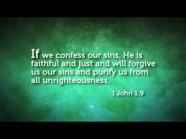
That’s what confession is. Confession is raising my hand in the sight of God and owning that what he has identified as sin, as foul, in my life is true. I’m thankful when we do that, the Word promises: he is faithful and just and will forgive us of all our sin and cleanse us from all unrighteousness (1 John 1:9). That should free us from looking to blame and enable us to live more honestly!

1j1.9.jpg

Advent: From Our Fears Release Us

WP 1john.4.18.jpg

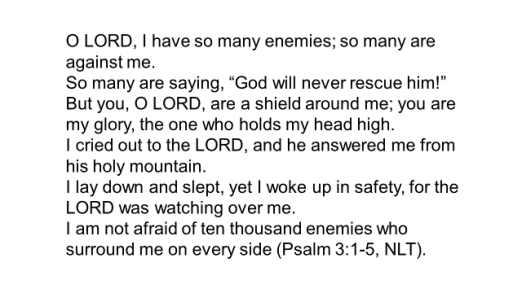
In my quiet time this morning, I was reflecting on Psalm 3:

wp-psalm-3

Fear. Fear bordering on paranoia. Bullying.
I read a news clip this week of a teen who killed herself because her peers had been bullying her. My heart ached, for her, for her family, for those peers.
What if this psalm had been breathed into her? What if God, God who could enable her to lay down in perfect peace in the presence of her enemies–and sleep–had been made real for her?
How real is he to me?
Save us, God, from our fears.
The words to an old hymn are in my head now:

Come, thou long expected Jesus, born to set thy people free;
from our fears and sins release us, let us find our rest in thee.
Israel’s strength and consolation, hope of all the earth thou art;
dear desire of every nation, joy of every longing heart. (Charles Wesley)

Oh that we could come to know the Perfect Love that casts out all fear.

Advent 2: Seek and Find

Yesterday we made reference to the childhood game of Hide and Seek as we considered the phrase: Ready or Not.

Is finding God like the childhood game?

not well hidden.jpg

I don’t think so, and here’s why.

When I began my faith journey, two Bible references were laid into my foundation.

Seek the Lord while he may be found; call on him while he is near (Isaiah 55:6, NIV).

God did this so that they would seek him and perhaps reach out for him and find him, though he is not far from any one of us (Acts 17:27, NIV).

Our being able to find God is of primary importance to him. We were created for relationship with him–and with each other.

It’s so important, we’re so important, that the often quoted verse from John’s gospel tells us he gave his son for us to not only know who he is and how he is, but so that we could have that relationship–now and forever.

Jesus wanted us to understand this principle and made it clear in his teaching we refer to as the Sermon on the Mount: Seek and you will find (Matthew 7:7).

So in these season of focus, what are you seeking? Who are you seeking? If you are seeking God, you will find him.

jer 29.13.jpg