Hopefully Devoted: Praying Specifics

2033DEDC-94E4-463D-8FF4-FF6574DC2082

Do you ever wonder if God gets bored with our prayers?

I know I do.

A confession like that from a pastor might sound odd. But it’s true.

If my prayers are all fluff and stuff, lacking substance or direction: what’s the point?

They begin to sound as meaningful as Charlie Brown’s teacher, “Wah, wah, wah wah wah wah.”

Jesus had an encounter with a blind man. He looked at the blind man and asked, “What do you want me to do for you?” (Mark 10:51ff)

The man didn’t hem and haw. He didn’t talk around the issue. He didn’t try to butter Jesus up to get him to do “whatever.”

To Jesus’ direct question, the man replied directly, “I want to see.” And that’s just what he got.

God doesn’t want us to hem and haw, dance around the issue, or butter him up.

God speaks us to directly because he loves us.

Why would we do any less?

Hopefully Devoted: Held

I, your God, have a firm grip on you and I’m not letting go. I’m telling you, ‘Don’t panic. I’m right here to help you.’ (Isaiah 41:13, The Message)

I don’t have a lot of words this morning. Some days are like that.

That doesn’t meant I don’t have something to share.

This morning, as I sat down to the keyboard, I didn’t find nifty words—I found presence.

My favorite image of God is that of a child curled up in his hand. Like this:

2C255157-FA19-4015-931A-59880D43C9D5

For me the most comforting and complete image of God is being held. I was told by a therapist that I’m touch deprived. The ache in my heart finds peace when I feel held.

Held together…when everything around me feels like it’s falling apart.

Held back…from foolish and destructive choices.

Held close…when the the ache of loss feels devastating.

Held.

Maybe you need to be feel held today.


Scriptures to read to reinforce: Psalm 91

Wednesday’s Word: Jesus

CEC60899-3B32-44A9-8725-95F47FE2639D

Do you remember being a kid in Sunday school—back in the day when the right answer always seemed to be “Jesus”?

It still is.

When you have no words for the hurt in your heart.

Jesus.

When you find yourself at the end of yourself.

Jesus.

When the hours are long and the night is dark.

Jesus.

Or, even when the joy bubbles over in a completely uncontainable manner.

Jesus.

Whisper it…Jesus.

Shout it…Jesus.

Beg, plead, weep it…Jesus.

There’s power in the name of Jesus.


Message Meme: Valuing Life

This week’s message will address the sixth commandment: Don’t murder.

As has been my practice in this series, I began my study by asking why would this commandment be important as God? God gives his rules to protect and/or grow us.

So why no murder?

Keep in mind these commandments are God’s foundational principles for the Jews who have just left Egypt and look forward to entering the Promised Land. They are leaving a place where their only value was their ability to work. God wants them to know their true value: he created them; he created them in his image; and he created them for relationship.

Those truths leave no room for murder—the intentional taking of another life.

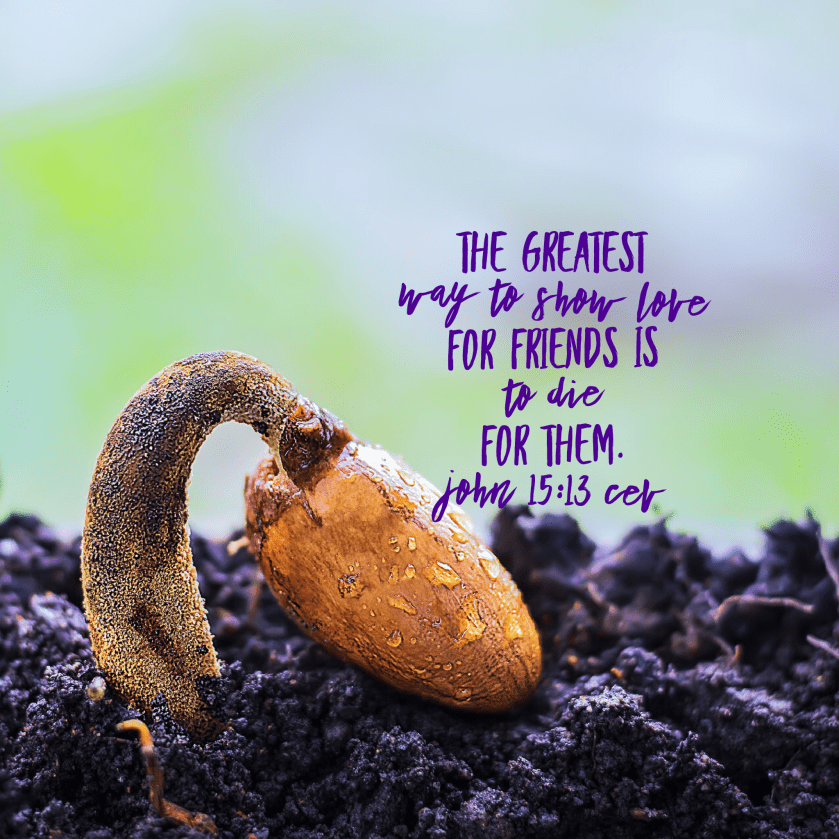
Put that on one side of the equation: disregard for the created and loved life of another and on the other Jesus’ words:

2A165ECD-CBF9-4EF5-9C6C-FA6CE4220F63

Would you give your life for anyone?

Sermon Seeds: It Starts At Home

528A6CED-C91D-4E6F-8816-4DB6F01B6554

The other day Asher and I went through the drive through at Burger King after school. This restaurant only uses their front window. The back window serves no real purpose—except for a glimpse into the inner workings.

As we waited in line, we watched a young man pealing and preparing onions. He didn’t appear to be enjoying the job. He grimaced as he pealed and sliced.

My heart went out to him. I’m not a fan of onion pealing, either.

But I love the image when it applies to understanding scripture. I relish the opportunities to pull back the outer (obvious) layers to discover the deeper meanings so I can come closer to the heart of God.

Looking at this text has pushed me to do that.

My online research seemed mired in studies that barely scraped the surface. The messages and commentary revealed a free-for-all of “Listen up, Kiddo, and do what your parents tell you.”

That can’t be the only reason.

Keep in mind these commands were given as God was seeking to develop the identity and community of his chosen people. The Spirit of the Law is God protecting and growing his people.

So God starts by making sure his people have laid the groundwork in their relationship: no other gods, no idols, carrying his name well, and resting in him. This fifth command is the transition from focus on their vertical relationship with him to the outer-workings of their relationships with others.

And it all begins at home.

The home is the place where we need to learn how to live and deal with others. Our relationship with our parents is a reflection of our relationship with God, and with authority in general.

The question that inevitably rises comes in the form of an objection or excuse: “But you don’t know how crumby my parents were.” “My dad left—I don’t have a father to honor.”  “My mom is just a drug abusing whore.”

I get it. My parents were alcoholics—albeit functioning, but complete with all the baggage that goes with. I grew up with the emotional uncertainty and the psychological scars.

In college, and later during my years of Clinical Pastoral Education, I came to realize God provided godly men and women who stood in the gap for me when my parents couldn’t. Some of them appeared as Girl Scout Leaders, or the parents of friends. Others were the spiritual leaders of Choirs and Folk Groups, and youth leaders at church.

And here, my friends, where the Church needs to perk up its ears—especially in our world today. Now, as much or more than ever, the church needs to lean in and live out the instruction to care for the widows and orphans. They are all around us and our responsibility is clear: we are family and we need accept the responsibility of getting this right.

May it never be said of the church: I have no spiritual fathers or mothers there.

There is no honor in that at all.

Hopefully Devoted: No Fear

D21B05BF-CE07-452F-85F6-AB5713D5F34D

The doctor looks down. Clears his throat. Then slowly looks up.

You look up and are surprised to see the plant manager at your machine, he’s holding an envelope and looking very somber.

As the door opens, the first thing you see is two suitcases.

The phone rings. It’s never good news at 2:00 in the morning…

Bad news comes in so many ways. Some days it feels like you can barely catch your breath before the next discouragement finds its way to your door.

I have friends who are awaiting surgery, hoping for good results from medical tests and court cases. Others are looking for work…still. A few haven’t been able to sleep for the anxious thoughts invading their dreams.

God has a word for us today as we fear the bad news knock on our door: They do not fear bad news; they confidently trust the LORD to care for them (Psalm 112:7, NLT)

The LORD is our shepherd, our healer, our door, our guide, bread, water, hope and light. No matter what it is we fear that could be waiting around the corner—God’s got it and you!

You can be confident in his care of and for you.

Wednesday’s Word: Determination

CB9D0674-1110-4B2D-90DB-46F76DA8CA3F

Determinination. The perfect word for January 31.

Statics show us the majority of people who made New Year Resolutions have already given up on them. Perhaps they were unrealistic or lofty. With every intention of reaching the goal they gave up when life got difficult or they got bored or another option caught their attention or fancy.

Disaster, disease,  and disillusionment throw detours in our path, and the easy response is to give up. The enemy loves when we give up.

The Apostle Paul knew a lot about discouragement, but he never gave up. He wrote this to the believers in Philippi: Not that I have already reached the goal or am already fully mature, but I make every effort to take hold of it because I also have been taken hold of by Christ Jesus (Philippians 3:12, HCSB).

I make every effort. I press on. With all the strength of the One who has taken hold of me, I grab onto that goal and keep moving forward.

No matter what. Don’t quit. Never give up. Here’s the good news: We are MORE than conquorers. We win. I know—I read the end of the book!

Stay the course. Keep determined. Hold to your resolve. How? Paul tells the Philippians that, too!

I can do all things through Christ who strengthens me! (Philippians 4:13)

Year In Focus: Selah…

smell6

I’m a shallow breather. Every now and then I end up taking a huge, full breath. It’s like I’m having to catch up. At 60, I’m used to the pattern. In fact it’s so natural for me that I often don’t realize that I’m doing it.

But those around me do, and they regularly ask me if something’s wrong because I sound like I’m sighing—at least that’s what I’ve been told. It’s gotten to the point that my husband asks, “Breathing or sighing?” He doesn’t want to assume and he wants to be sure I’m okay.

I don’t know how long I’ve done this. I asked a doctor once about it, but they sort of blew the whole thing off as a non-issue. So I don’t worry about it.

But I wonder. This forgetting to breathe sometimes feels like a metaphor for my life. I move at a pretty fast pace. I take on a lot. A little improvement has come with age and awareness (aka acceptance) of my limitations.

How does this apply to my theme this year of stillness and rest?

I’m glad you asked.

16AE0876-B506-4AD8-86CC-AD9C36375BD4

I need to learn to pause. I can’t keep going at a speed that leaves no room for breathing.

Last week I was reading in Psalms, the prayer book of the Bible, and I noticed a word I tend to skip over. My New Living Translation uses the word “interlude.” Older translations have the word, Selah, set off to the side. Essentially, the word is an invitation to pause. To take some time consider the previous verses—to let the Truth sink in deeply.

I don’t know about you, but I like that…I need that. And not just when I’m reading scripture. I need to schedule in time to reflect the same way I am intentional about getting up and moving each hour (Thank you FitBit).

My recent reading about sabbath reinforced the truth that it is not simply empty inactivity, just as spiritual fasting isn’t merely not eating. Pausing to catch my breath isn’t Selah. Inherent within Selah is the spiritual practice of reflection, listening, and focus. It won’t happen unconsciously or outside of my intention.

So today, I will be looking for moments to stop, breathe, and reflect. I hope you find some, too.

303F3EE3-AF33-4F15-97EB-504F6C4E3852

Sermon Seeds: Take Time to Rest

517D87EB-FAC6-4F14-81BF-9A2988C454A9

Remember the Sabbath, and keep it holy (Exodus 20:8).

The Sabbath was made for man (Mark 2:27).

Let us make every effort to enter that rest (Hebrews 4:11).

What do we do with God’s instruction to keep Sabbath? How do we do it in the 21st century? So much information is available about the topic of Sabbath…and a lot of opinion.


What if instead getting lost in the legalism of keeping—like the Pharisees did in Jesus time—we just decided to, as Lynne Baab suggests: “just establish sabbath patterns that nurture intimacy with God (p.12, Sabbath Keeping).”

Merely emptying our day of certain activities is like suggesting fasting is just the absence of eating. If we don’t fill up the time with God-honoring relational activities the absence is just absence…it’s meaningless.

And what about the people who have to work on what we would typically consider the Sabbath or Lord’s Day (and don’t get me started on the differences)? Are doctors, nurses, firefighters, and police—to name a few—doomed and damned because their schedules require them to work? Is it ok for pastors whose number one work day is the Lord’s Day to carve out time on a different day of the week?

Does Jesus look at us with our scattered and scurry-filled lives and offer the same invitation he gave to those who he saw chaffing under the unbearable load of rules and expectations?

“Are you tired? Worn out? Burned out on religion? Come to me. Get away with me and you’ll recover your life. I’ll show you how to take a real rest. Walk with me and work with me—watch how I do it. Learn the unforced rhythms of grace. I won’t lay anything heavy or ill-fitting on you. Keep company with me and you’ll learn to live freely and lightly (Matthew 11:28-30, The Message).”

Baab tells of a woman, Ann, who had been keeping sabbath for over 30 years. She says: “The sabbath is one of those gospel duties that absolutely convinces us of the goodness of God. The more we practice it, the greater a privilege it becomes, the more essential it feels, the deeper it connects us to the river of life that provides fruit in all seasons…The sabbath-keeping command is like the promise, “O taste and see that the Lord is good (p. 17, Sabbath Keeping).”

One more thought from Baab: Only in stopping, really stopping, do we teach our hearts and souls that we are loved apart from what we do (p. 18, Sabbath Keeping).

As a child, back when we Sunday afternoons were heavy-laden with restrictions, I didn’t understand why…and I had no appreciation. None of it seemed like a gift. It was a lot like fasting: I just came away wanting more—but never more of God.

It’s quite revolutionary to think that this command to rest comes as part of God’s lavish love for us and his amazing grace.

Hopefully Devoted: You must be…

3D2E1E65-203F-4ADD-9AFB-7ABA6EB4CCF3

14 Yes, the body has many different parts, not just one part. 15 If the foot says, “I am not a part of the body because I am not a hand,” that does not make it any less a part of the body. 16 And if the ear says, “I am not part of the body because I am not an eye,” would that make it any less a part of the body? 17 If the whole body were an eye, how would you hear? Or if your whole body were an ear, how would you smell anything?

18 But our bodies have many parts, and God has put each part just where he wants it. 19 How strange a body would be if it had only one part! 20 Yes, there are many parts, but only one body (1 Corinthians 12:14-20, NLT).

I had a very unusual interview this week. I will confess I was taken aback initially—it wasn’t what I expected—but I love the way it turned out!

As is my typical fashion, I showed up early. I always allow extra time for getting lost or behind a slow moving vehicle. Thankfully neither of those things were going to be an issue since the interview was just a couple blocks from my church office.

Well, I sort of got lost since I went to the wrong office suite first, and then couldn’t find the other in the maze of office suites.

When I finally made my way to the correct location, I was warmly welcomed by the coordinator of the interview. Ah, I felt my anxiety drop a couple notches.

Then it happened. One of the people in the group area looked at me and said, “You must be Tina.”

I stopped dead in my tracks and said (in an exaggerated and goofy manner), “Oh darn. I thought I was going to get to be someone else today.”

Fortunately she laughed and others joined in.

Sometimes I forget how to be serious.

But that is who I am. If you’re going to tell me I must be me, then I will. And Tina finds the humor in almost every situation.

I use humor to diffuse. I use humor to deflect. I use humor to get close. I use humor to disarm. I use humor to adjust perspective.

Please understand, I know how to weep—because there’s a time for that. I know how to lament—because crying out to God is necessary and healthy. I know how to be quiet, and serious, and respectfully silent. I can do those things…and do.

But God wired me to find the levity. God made me light-hearted. God made me. So I must be.

I guess in the body of Christ, I’m the funny bone. Not that I’m always funny or telling jokes. In fact I’m horrible at telling jokes—I always mess up the punchline.

Have you heard the old saying, “Rings on her fingers, bells on her toes, she shall have music wherever she goes”? I won’t always have music, but I will have laughter.

In the scripture quoted above, Paul is trying to help the Corinthian church understand the body of Christ, what we might identify as the church. They were caught up in valuing certain gifts and talents above others. Paul wanted them to see how all the gifts/talents are necessary, and in fact placed right where God wants them to be.

So if you must be you—where are you in the body? How does God want to use you?

I like the way Dr. Suess put it:

A8261752-CDBE-450F-BAB5-8F184FBA3C5E

Oh, and the interview went very well. I think I’m really going to enjoy working with this group of folks!